


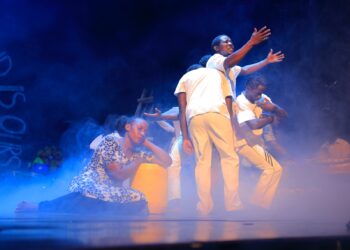
When Chief (Stanley Okeke) walks on to the stage, Austine Onuoha’s National Cake is about to transform your primary thoughts of relaxation, community, and bonding into a theatre stage you never imagined seeing. It entertains, educates, and edifies.
Terra Kulture’s open-air theatre functions, in many ways, as a community theatre here, and as is the nature of community theatre, the distinction between actors and audience is deliberately blurred. The conversational nature of these performances make it the perfect fit for Austine Onuoha’s satire, which brings Nigeria under one roof and uses family tension to explore the country’s national and political strife. As both the writer and director, Onuoha uses the technique of finding in the family a microcosm of the country (quite a favoured technique, think Yerima’s Hard Ground) and excels in it.
Chief is a Nigerian politician who, after twenty-five years of being a “loyal party member”, decides it’s his turn to lead the nation. He knows he has to be strategic to secure victory at the polls, and as is the nature of the short-sighted politicians he represents, one of his strategies is to belong to the three major ethnic groups of the country by marriage. By marrying from each of the ‘ethnic’ groups, he connects to them as a son-in-law, and proves that he is capable of uniting the country across ethnicities, or so he believes. It is a ridiculous arrangement and one that leaves the audience bursting at the seams with laughter, for what other options do they have? For sure, we could not cry.
See also: Wano Waife: Interrogating Social Realities and Dialogue on the National Theatre Stage
Chief’s house quickly devolves into chaos. Every one of his wives schemes to become the First Lady, and that quest for power turns the house into a riot of comedic commotion. Jumoke (Rodia Lawal), the first and oldest wife, argues that the position of the First Lady is rightfully hers. She is Chief’s childhood love who was with him way before he had his fair taste of the national cake.

Miriam (May Okanigbe) sharply disagrees, for First Ladyship is not a race for the old or a reward for suffering but a position for the most educated. She has a postgraduate degree in Political Science; moreover, her father, a wealthy man from the northern part of the country, only agreed to let her become the second wife on the understanding that she would be the Chief’s favoured wife for political positions. These points mean nothing to Nkay (Chinonso Young). As the newest and most physically endowed of the Chief’s wives, she believes it is her duty to be where the cameras constantly roll, a picture-perfect wife always ready for the public gaze.
Austine Onuoha’s National Cake is a bold, humorous play. It is not interested in ridiculing individuals as much as it is interested in exposing flawed systems and mindsets, but when it does ridicule individuals, no matter how highly placed they are, it leaves nothing to the imagination about who these individuals are. It bites and stings in its humour and gives fear no chair on the lawn. This it does through superb storytelling.
See also: Walking Into The Night To Make A Day: On Uzor Maxim Uzoatu’s A Play Of Ghosts
In its turn of phrases, its subtle and sublime jabs, the pacing of its scenes and the progression of its plot, it tells a tight, properly cooked story, one that is easily accessible yet sophisticated in its presentation. By the time the final twist comes, by the time it is revealed that the strategic Chief has devised yet another election victory strategy, the story comes neatly together while the laughter reaches for the crescendo.
The actors do justice to the story. Their range is impressive, and they have mastered the art of saying much with just facial expressions. Even more impressive is their audience’s interaction. Stanley Okeke excels the most here in how he is able to interact organically with a random member of the audience, who for that moment becomes part of the cast, and still successfully transition the conversation back to the script. Those unscripted moments are what make open-air theatre what it is.

Satire has remained a favoured technique in the theatre and will continue to remain so because of its magnificent usage in plays like this. When the curtains are drawn (there are no curtains), or the lights go off (it is open-air so there are not really lights to turn off), whenever the shifting category of cast and audience decide that the play is over, and Chief returns to his room with his latest strategy, Enobong (Ivie Oshodi), the laughing spectator goes home thinking of one scene and what it means to them. I went home thinking of one particular scene where the wives decide that Chief must wear something that shows more inclusivity. Chief, a Yoruba politician, is on his way to a function with his Yoruba first wife when the other wives enter and decide that Chief must reflect the diversity his household so vividly mirrors.
See also: Nyokabi Macharia: Marching to the Beat of Her Own Drum
Their idea of inclusivity is to have Chief wear articles of clothing from the three major ‘ethnic’ groups at the same time. By the time they are done and satisfied with the result, Chief is a masquerade. I think of that scene, and I think about how often we dress up our differences rather than seek to understand them, discover the strengths they hold, and bring them together for the greater good. I think that Stanley Okeke’s casting as the lead character is intentional in the way it shows that beneath the bodies that carry these different histories runs the same fluid. For the mild surprise was visible on the faces on the lawn when, at the end of the play, the actor who has played a Yoruba character to perfection, speaking Yoruba in a Yoruba accent, and embodying the full range of the “Yoruba mannerisms,” is revealed to be Igbo. Nothing shows the randomness and fluidity of the differences we bicker over better than that moment.
To eat the national cake, as every Nigerian knows, is to eat that which belongs to the nation, as an individual or a group. It is corruption, it is harmful, and fighting it, Ngozi Okonjo-Iweala tells us, is dangerous, but it is not necessarily an evil thing in the Nigerian psyche. It is only evil to those who are excluded from the table where the national cake is shared, and many of these are not against the vandalisation of this cake as much as they are for being the vandalisers.
National Cake, written and directed by Austine Onuoha is a production worthy of seeing, and while I commend the producers, Ihuoma Daniel-Onuoha and Tobenna Amaechi, I unreservedly recommend you see it. National Cake is running at Terra Kulture until 30th August, 2026.




Discussion about this post