


The Tiv people of Nigeria have a storytelling tradition called kwagh-alom, where a family gathers at the end of the day’s work, in the early hours of the night, to listen to stories and folktales by creative storytellers, mostly elders of the family. It is similar to what the Igbo people of Nigeria refer to as Akụkọ Ifo told during Egwu Ọnwa, when children of the community gather on a moonlit night to play and hear what is commonly referred to as tales by the moonlight. There is no shortage of such storytelling practices across the nations that make up the Nigerian state.
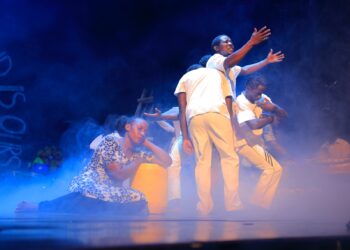
The Tiv kwagh-alom is the root of its kwagh-hir, a theatrical performance of “composite art form encompassing a spectacle that is both visually stimulating and culturally edifying.” (UNESCO) In kwagh-hir, the story is not just told; it is dramatised, sung and danced. Poetry has its place and so does puppetry and masquerading. It is this theatre that Tobenna Amechi’s “An Evening of Kwagh-Hir” promises.
See also: Nyokabi Macharia: Marching to the Beat of Her Own Drum
Patrick Diabuah emerges as the Chief Storyteller of the night. He opens with the familiar tale from Igbo folklore: how the tortoise broke his shell. The tortoise, it is said, had joined the birds for a feast in the heavens with a wing formed by a collection of feathers from each of the birds. It is a tale of how the tortoise flies on the mercy of the birds, and even that does not prevent him from displaying the craftiness with which he is known. He devises a clever naming system that allows him to be called “All of You” such that when their host in heaven announces that the food and drinks prepared for the feast belong to “All of You,” everyone understands this to mean that they belong to the tortoise. This deception consequently leads to the birds retrieving their feathers. The tortoise, having lost his acquired ability to fly, free-falls upon the earth, shatters his shell, which is then patched to give it its current look.

It is a well-known story in African folklore, but Diabuah is able to captivate his audience while telling it due to how well he embodies the story, theatrically bringing it to life.
He is able to do the same for his next story, a lesser-known story: that of the great hunter and the talking skull. The skulls he brings along to tell the story, coupled with his ability to turn his audience into actors and actresses, heightens the thrill of the story. What emerges is a communally owned theatre, where everyone is an active participant, as Diabuah leads the rehearsal and subsequent acting right there and then.
See also: TATM in Converstion with Paul Ugbede Full Interview
The last story of the night was told by Tobenna Amechi, who closed the night on the same note it started by telling another version of how the tortoise cracked its shell. In this version, there is a famine in the land, and all the animals have something to eat. Squirrel stages its aged mother’s death while hiding her atop an iroko tree. While on this iroko tree, Squirrel’s mother discovers a path into heaven where food is abundant. An unexpected plot twist. Every time Squirrel sneaks off to the iroko tree, he sings their secret code, and his mother throws down a rope with which he ascends.
Tortoise, cunning as always, discovers this secret and learns the code, which he too sings, and the rope comes down. However, as he gets closer to heaven, Squirrel’s mother sees it’s not her son on the rope, and she cuts the rope, sending Tortoise crash-landing on earth. And there goes another food-related tale as to why the tortoise’s shell is the way it is.
As is common in such moonlight-setting tales, at the end of each story, the moral lessons are discussed, and questions are asked and answered. Messages are debated, wisdom received is questioned, and traditions are taught and learnt.
See also: A Tribute to Athol Fugard

Tobenna Amechi’s “An Evening of Kwagh-Hir” aims to recreate the village communal setting in a fast-paced individualistic city. It asks its audience to slow down, unwind, and reconnect to their roots while building a community through craft-making sessions (led by Melody Mmaduakor) and the games that demand everyone’s attention and participation. It recreates the relaxed atmosphere of the moonlight gathering, with a seating arrangement that ensures that everyone can see and be seen by everyone. Fancy bulbs replace the moonlight and processed juice, whatever might have been consumed on those nights, but these material differences do not erase the original spirit of the night. Like we say in Nigeria, fun was had.
See also: It’s A National Cake, Let Us Laugh, For We Cannot Cry
In its second edition, “An Evening of Kwagh-Hir” is yet to deliver on its promise. It is yet to grow above kwagh-alom, its roots, to properly become a theatrical performance of composite arts. And it is still unable to chart unfamiliar territories. It is good to retell stories we already know, and such a retelling is important, but it is equally important to tell new stories emanating from the times we are in. The time requires not only that we use fancy bulbs in place of the moonlight but also that we bring the ancient core to our modern setting. Our folktales must grow with us, the repository a growing, ever-expanding entity, not condemned to a museum where it collects dust. Also, it is important that folktales from the different regions that make up Nigeria, not just those of one, are told on such nights. Like someone in the audience mentioned during the feedback session, there wasn’t even a single Tiv story in an evening of kwagh-hir.
Tobenna Amechi and his team have run an experiment that didn’t fail. Yet, it has shown areas that must be improved. The promise is there. One can only imagine what this dedicated team would achieve in the third edition, as they refine their craft.


Ray ID: 8f3a2c1b9d4e5f6a · Performance & security by Cloudflare
site-verification-ok




Discussion about this post