


If you want to understand a nation and its people, look no farther than its art. Through a country’s paintings, poetry or drama, the treasures, the dreams and aspirations of its people are stripped bare. Of all art forms, theatre is the most emblematic of the social and human experience of a time, thanks to its immediacy. Theatre is, in the words of Laurence Olivier, the ‘outward and visible sign of an inward and probable culture’.
Perhaps no art form has documented the Ugandan life as vividly as theatre. Gwe, you don’t have to scour through history archives or anthropological recycle bins to understand the Ugandan character. The truth is in drama. The following dramatic works, masterpieces in their own right, embody the Ugandan situation. They are plays, written, directed and/or produced by Ugandans for Ugandan audiences between 1965 and 2015. Over the years, the fears and tears (and very rarely the cheers); the struggles of Ugandans have been captured through the theatrical lens of the Uganda dramatist. Ladies and gentlemen, 10 plays, 10 playwrights, 10 beautiful slices of Ugandan life, in no particular order:
- Oluyimba lwa Wakonko
Byron Kawadwa’s Oluyimba lwa Wankoko (translated as Song of the Cock) is a political allegory of President Apollo Milton Obote’s 1966 abolition of kingdoms and the then Uganda constitution to usher in a republic. By and large an opera, it is the story of Wankoko, a foreigner, who is hosted into a court only to turn out as a master. Master or monster? In an ingratiating scheme, Wankonko dupes a young prince, Suuna, that he can help him win the love of Birungi, a princess from another kingdom. As things turn out Wankonko courts Birungi for himself. Kawadwa, a Muganda loyalist, caricatures Obote, a non-Muganda who stormed the palace of Edward Muteesa II (then king of Buganda and president of Uganda) and assumed full presidential powers. Yet the play, like all good plays, elicits varied interpretations. To some, the stranger is the white man who comes to Africa to assert his colonial dominion over the original inhabitants. To president Idi Amin who succeeded Obote, Oluyimba lwa Wankoko was a searing attack on his murderous regime. Little wonder, that in 1977, a few days after the play had been staged in Lagos at FESTAC, the Second Black and African Festival of Arts and Culture, Kawadwa was ‘picked’ by state operatives from a post-production meeting at the National Theatre and thrown into the boot of a car. Never again would Kawadwa see the lights of stage or the light of the day.

- The Bride
In The Bride, Austin Bukenya pours scorn on social segregation through an inter-generational conflict between elders and the ‘rika of albinos’. When the elders refuse to initiate Namvua on grounds that her ancestors were foreigners, and instead marry her off to a skull, a group of young initiates led by Lekindo accept Namvua and go their own way to redeem her from a dehumanising relationship. How Bukenya deftly builds a strong love story between Lekindo and Namvua amid this blistering conflict of the old and the young is what makes The Bride a superbly-crafted drama. It is a story of hate and love; of subjugation and redemption and everything in-between. First performed in 1972 at the Nile International Conference Centre in Kampala, The Bride was timely as this was the year President Amin expelled Asians from Uganda. Almost 50 years later, it is still relevant, considering that tribal clashes in some parts of Uganda and xenophobic attacks elsewhere on the continent are rife.
See also: Mbuso Khoza on why the Battle of Islandlwana remains a pivotal moment in African history
- Black Mamba
It is never easy to choose a play from the John Ruganda canon. In play after play, Ruganda made a repository of the Ugandan, if rather African, condition of his times. His humour was large, his satire sharp. In Black Mamba, Berewa, a professor’s houseboy plots to have his wife, Namuddu lure his ‘loose-panted’ master in a state where prostitution attracts a prison sentence. Drama ensues when Namuddu’s true identity is revealed to the professor. When the play was first performed on October 3rd 1972 at Makerere University, the elites could not help hiding their guilt at the failings of one of their own. Similarly, Berewa and Namuddu’s desperate will to survive, like their generous poverty, gnawed at the hearts of the rest of the Ugandan population; and has continued ever more.
- Majangwa: A Promise of Rains
One of the most sagacious playwrights of his age, Robert Sserumaga proved his intellectual prowess in Majangwa: A Promise of Rains. In tautly inter-woven dramatic forms of African indigeneity and Western avant-garde, particularly rendering Samuel Beckett and Eugene Ionesco’s Theatre of the Absurd, Majangwa employs the usual absurdist motif of duality. Husband and wife: Majangwa, a former drummer, and Nakirijja, a dancer, resort to sexual displays to willing voyeurs in an attempt to reclaim the past glory of their career. With such a potent theatrical idiom, Sserumaga makes a social indictment of Uganda in the 1970s. The hopelessness of the people, as seen in the voyeurism and the economic stagnation that the waning career of Majangwa and Nakirijja, makes a relevant dramatisation of the times. Moreover, the play’s issues still reverberate through up to the present day. Strip off Majangwa and Nakirijja, drop the veneer of civilisation, modernity or political rhetoric and you will encounter the dire reality of a 21st African state. The play was first performed in 1971 at the National Theatre with Sserumaga in the titular role.
- Mother Uganda and Her Children

Certainly one of Uganda’s ‘most-travelled’ play, Mother Uganda and Her Children is Rose Mbowa’s major work. It is very Ugandan, seamlessly blending traditional song, mime and dance from different ethnic cultures in Uganda. The dramatic action revolves around Mother Uganda’s troublesome son, Tabusana. Warmongering, Machiavellian and morally bankrupt, Tabusana is all the ugliness you can think of. His eventual transformation is the play’s message to a country torn to shreds by civil strife, tribalism and political plunder. The play was first commissioned by the Africa Centre in London in 1987. It was performed in the Makerere University Main Hall, the National Theatre in Kampala and later in other countries such as the Netherlands, Libya, Kenya and the UK. The Uganda government which was on a national rehabilitation of the country after a series of civil war found Mother Uganda and Her Children a panacea to that national problem.
See also: Incubator 7: POPArt’s Innovative Response to Covid-19
- Ndiwulira
Written by Charles James Senkubuge Siasa and directed by Andrew Benon Kibuuka of Bakayimbira Dramactors, Ndiwulira dramatised the ghastly ramifications of the HIV-AIDS scourge of the late 1980s and early 1990s. It is a domestic drama filled with intrigue, revenge, jealousy and ignorance. Samantha, a femme fatale, sleeps with Uncle Saulo who then sleeps with Kaawa, a brother’s wife. In another array of dramatic coincidence, their children are also sleeping around until HIV consumes the entire family. When the play opened at the now-defunct Pride Theatre in Kampala in November 1991, audiences sat on edge, cursed and wept at the unapologetic truths relayed on stage. It went on a nationwide tour and was one of the secrets behind Uganda’s HIV-prevention success stories.
- 30 Years of Bananas

Arguably Uganda’s hugest box office success of all time, 30 Years of Bananas by the legendary Alex Mukulu was launched in 1992 to mark 30 years of Uganda’s independence. The play chronicles the life and circumstances of an ordinary Ugandan through eight political regimes. The story is told by Kalekeezi, a man of Rwandese descent who has served all the past presidents. Now a tour guide at the National Museum, Kalekeezi takes tourists through the good, the bad and the ugly of the men that have been at the helm of Uganda. The tourists make a Greek-like chorus lacing the action with chant and song. Spectacle is undoubtedly the play’s greatest achievement: the busts of the fallen presidents at the museum are visceral and poignantly dig at the emotionality of the audience, constantly sighing: see how the mighty have fallen. Phillip Luswata recently reproduced the play at his Playwrights’ Playhouse in Kampala.
See also: Lessons from the Online Stephen J. Chifunyise International Theatre Festival
- Lady, Will You Marry Me?
It is an oft-whispered question in the ears of the fair sex. The answer is usually obvious. Or is it? So what does Lady Mouse do when Mr Cat asks for her hand in marriage? In folklorist Mercy Mirembe Ntangaare‘s play, Lady Mouse accepts to marry Mr Cat. Before long the incompatibility of their relationship emerges. Intrigue, ego and mistrust, particularly after Mr Cat becomes President of the Mouse-Catland Federation, sets in. Truth dawns on Lady Mouse that Mr Cat cheated her of the jointly-owned bridal cheese, a symbol of their relationship. In a heart-in-the-mouth dénouement of the tragedy, Mr Cat kills Lady Mouse. The style sounds lucid and audiences may recall The Insect Play by the Capek Brothers or that timeless Orwellian classic called Animal Farm, but the issues dealt with are deep. That was the realisation when it opened in 2002 at the National Theatre in Kampala with Robert Kyagulanyi Sentamu alias Bobi Wine (now MP) playing Mr Cat and Barbara Itungo (later Mrs Kyagulanyi) playing Lady Mouse. It cast a light on subjects the public often sweeps under the carpet such as gender-based violence and political machinations. As if the play were a precursor, the then Vice president Specioza Wandira Kazibwe sought divorce from her allegedly abusive husband, Charles Kazibwe (RIP) a year later.

- Cooking Oil

Cooking Oil by the award-winning playwright Deborah Asiimwe mercilessly lampoons the upward spiral of corruption characteristic of most developing countries. 18 year-old Maria siphons off foreign aid given to her village in form of cooking oil little knowing this will lead to tragic consequences. But Maria is not alone. Whereas Maria is saving for her education, Silver Bibala, a shrewd politician, is using money from the oil boom to finance his presidential ambitions. Their oily hands soil the others. When Maria is later murdered many dirty hands are found inter-locked in a greasy frying pan of corruption. Asiimwe reveals a tangled web of corruption at family, local and international levels, and it is this that makes Cooking Oil an undeniably brilliant play. More brilliant is the play’s interrogation of foreign aid and the powers in charge of it. Since its premiere in 2010 at the Uganda National Theatre, Cooking Oil has enjoyed adorable reception not only in Uganda but in the US as well and continues to be on the menu of theatre and literature programmes at colleges and universities.
- Silent Voices
Adong Judith’s Silent Voices (translated as Dwon ma Peke in the Acoli language) is a loud voice for the victims of the 20 year-old civil war in Northern Uganda. First directed by Dennis Reid in 2012, the play makes a strong case for the everyday men, women and children who lived through the war but are now marginalised as the government instead seeks to reward the former Lord’s Resistance Army rebels. Silent Voices is not just anti-war theatre but raises the need of rehabilitation for those undergoing post-war trauma. Isn’t justice the first rehabilitation? The question this scintillating drama raises is unmistakably relevant to a continent no stranger to conflict and war.
See also: Uganda’s Elvania Namukwaya who Broke the Glass Ceilling of Theatre
It is not easy to reduce a country to just 10 plays. Theatre, after all, is just a slice of life and the Ugandan experience or condition is as varied as the heterogeneity of its people and history. There are certainly many plays and playwrights, if not all, that have been on the Ugandan stage and would be on this list. The list is therefore not a summation of the Ugandan story but an attempt to understand the subjects that generations of Ugandan dramatists have been pre-occupied with and that way have a sneak peek into the lives, the struggles and hopes of the Ugandan people as dramatised on stage. Needless to say that the above plays are worth studying, directing and producing again by anyone interested in African theatre, for the issues they deal with are not just Ugandan but endless and boundless.
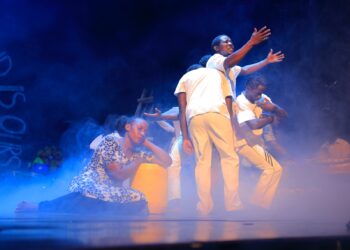
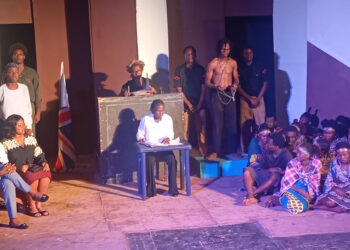
(Photos by Playwrights’ Playhouse, the Uganda National Cultural Centre, Mebo Theatre, Silent Voices Uganda and Tebere Arts Organization).





Discussion about this post