


From the 21st to the 23rd of April, 2026, I had the privilege to attend the Festival of Nine Plays at the University of Nigeria, Nsukka, hosted by the school’s Department of Theatre and Film Studies. This three-day event was a wonderful showcase of nine plays by African playwrights, directed by the penultimate students of the department, in fulfilment of the requirements for their Directing course. The evolution of this semester’s exam into a university-wide theatre deeply interested me. Mr Kasarachi Collins, a graduate of the department and currently one of its lecturers, said that the course, which was designed to be the students’ first experience with directing, used to be more modest when he was a student. Then, they only needed to direct a scene, two at most, to pass the examination. With time, however, and under the coordination of such senior lecturers as Dr Ndubuisi Nnanna and Dr Ikechukwu Erojikwe (the current course coordinator), it blossomed into a festival.
While the festival is a celebration that the entire university eagerly anticipates, for the penultimate students of the department, it holds a much higher stake. They have one opportunity to bring these stories to life and one shot to give everything they have to the plays they have chosen to direct in hopes of earning a place among the productions selected for the festival. Mr. Collins could only describe it in one way: a healthy competition. And a fierce competition it is.
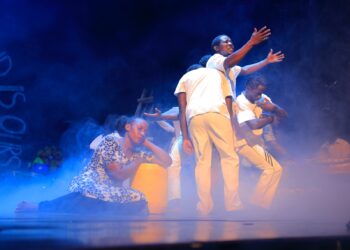
For Chinenye Joseph, who co-directed Ben Binebai’s The Dance of the Ghost alongside Cynthia Eze and Clinton Ukatu, the festival became a journey that ended in triumph. Their production staged the festival’s final night and ultimately emerged victorious. The selection process is brutal. From an initial pool of a hundred plus of plays chosen by students, one must survive the chopping block to advance to the next stage of fourteen. For one’s play to stand out and remain after such a demanding selection process is no small feat. While I spoke with her, I saw exactly what Mr. Collins had meant when he described it as a competition without prizes, yet one whose rewards were truly priceless. Her countenance reflected a deep fulfilment, and she had more than a thousand reasons to be. Not only did she make it to the final stage, but the production itself was arguably one of the best among the nine, presenting wholesome characters like King Ikeime (Chinemerem Nwafor) and Queen (Favour Ezeugwu).
Ezeugwu and Nwafor are actors who commanded the stage with remarkable presence. They portrayed a king and his wife, a corrupt leader and his wife, through whom the spirits expose the evils of the king. Theirs were characters that are, to use Nwafor’s word, intense. I spoke to them to learn how the casting choice was made, with a desire to learn how they were able to embody their characters almost to perfection. The casting, I learned, lies solely with the directors. No auditions were needed, nor were they done. They were a class that knew one another well, and although this was their first directing production, they had previously worked together in other class productions. They’d watched each other act, sing, dance, and design. It was upon this foreknowledge that the directors relied to cast Nwafor and Ezeugwu as King Ikeime and Queen, respectively.
See also: Trauma, Faith and Identity Jonathan Sasha’s Die Stoep
Their excellent performances on stage were a result of constant rehearsals, careful attention to the director’s guidance, and, most importantly, a deep reading and understanding of their characters, an act Nwafor refers to as ‘directing yourself after the director has directed you’, and that is the biggest lesson Nwafor learned from the course.
And the story is the same for Divine Chidera Peter, who played the comedic character of Solomon in This Season’s Harvest (second night of the festival) to perfection. For Divine, the course has exposed him more deeply to how difficult it is to work with humans, to manage humans, and has cemented his decision not to have anything to do with directing going forward. Acting, on the other hand, comes naturally to him, and it is a talent he does not betray.
In playing Solomon in the otherwise tragic This Season’s Harvest, he became the play’s balance of comedy and tragedy. In him was the outlet for the comedy that the playwright embedded in the play. Just like Nwafor and Ezeugwu, Abraham Ogonna Akamu, Ukamaka Charity Eric and Emmanuel Tochukwu Igwe (directors of the play) selected Divine based on his already known acting skill. Comedy comes naturally to him; the character of Solomon was one role he didn’t need much preparation to get into, for he is Solomon in his real-life. This, in my observation, presents him with the double-edged sword of being typecast as a clown. He was similarly cast as some funny side characters in some other plays during the festival, including as Ramoni in Wizard of the Law. One can only hope he doesn’t fall on the edge of this sword that severs creativity.
Peculiar Chukwuka was a prominent member of the crew across two of the plays. An assistant director in Mad Medicus, and the costume designer for the Vivian Festus, Ifeoma Chukwuemeka and Paschal Amaechi-Achu-directed The Candles. It was for this costume designer role that I spoke to her. I was intrigued to learn what her routine for selecting costumes was. Like many costume designers, her process was rooted in research. She went online to study what people from that particular time and setting wore, and consulted classmates who came from cultures similar to those characters. and she allowed her creativity, that quality Ukatu insists a director cannot do without, to fill in the gaps. For all her efforts, though, a lot of constraints beyond her control still hampered her delivery. For example, she could not get the appropriate costumes for a Catholic Archbishop character and had to make do with just a free-flowing white gown and a black zucchetto. And such challenges were not peculiar to her. While managing the students could be a great challenge, both Mr Kasarachi Collins and the directors admitted that the technical challenges proved to be the most disruptive. The second night was the worst in terms of these technical challenges. Almost an hour was lost due to a power outage.
See also: Dr. Julisa Rowe: On Drama, Ministry and Giving Back to the Next Generation
It is no news that the power supply in the country is epileptic, to put it nicely. Individuals and organisations therefore resorted to other means of rectifying the situation. Power banks have become as mobile as the mobile phones whose batteries they keep. Noises from generators, mostly powered by petrol and diesel, have become a central part of the country’s soundscape, and those who can afford it have invested in the use of solar panels. The power outage couldn’t be ignored. The Department of Theatre and Film Studies was well-equipped with a generating set for the Arts Theatre, but for reasons unknown to most, it failed repeatedly that night. One could only assume that nobody bothered to ensure that the generator was in a good operational state before the production.
The true solution to this problem is to have a country that can deliver 24/7 electricity to its citizens. But until then, the Department has to find a way of solving it for themselves. One way, as suggested by Chinemerem Nwafor, was to go off-grid for the duration of any production at night, to prevent such situations of relying on the national grid, and running around to turn on the generator when power fails, losing valuable time and destabilising the thespians on stage.
The costume challenge is one acknowledged not just by Peculiar Chukwuka but also by other members of the different crews I spoke with. They noted the unavailability of costumes for the traditional dresses of characters from the other ethnic groups in Nigeria, and even the Igbo ones available are outdated. Chukwuka, who has been in the Costume unit for a while, noted that this has led to a decline not just in the quality of their productions but also in the number of people who patronise their unit. Normally, students and others in the university community or nearby come to them to hire costumes for whatever need they have. Such patronage peaked during the Students Week as Costume Day is part of the celebration. However, that patronage has greatly declined due to the poor state of the few available costumes, making even students of the department look outside their unit for costumes for their class productions. She wanted the department to invest more heavily in the costume unit, noting that it would not only improve the quality of their stage productions but also serve as a source of revenue for the department, as it used to do.
For Divine, it is also important that the department work on the Stage. He found it too constricted for an easy flow of movement. To that, I would add that the House can be improved upon, especially in terms of hygiene and aesthetics. The air circulation was quite poor owing to the non-functional state of some of the fans available. It would also be great if the department goes digital with high-quality coverage of the productions (pictures and videos), which could then be uploaded to their social media pages and such streaming spaces like YouTube. A live stream of the production as it happens can be an extra way of generating ticket sales, providing theatre lovers who cannot be physically present with an opportunity to still join the festival. Most importantly, this digital coverage can help document and preserve the memories and can be used by the students involved to build their portfolio. It is extremely sad that at this time and age, it is still easier for the bull to pass through the eye of the needle than for one to get quality stills from the productions from the department.
See also: Leonard Okware: 39 Years Behind the Lights
For Emmanuel Ikechukwu Imemba, a final year student of Microbiology at the university who witnessed the last night of the festival, the Chorus, which was his best part of the experience, was also the part he had the most issues with. While he found it “promising and uplifting,” he also noted that a lot of “improvement is needed.” Giving an example with The Dance of the Ghosts, the last play of the festival, he observed that “at some points the songs took no consciousness of the scenes,” being too loud such that it drowned the dialogues. He also noted that some of the actors needed to learn “that being overly energetic is not all there is to acting.” While Ukatu called on directors to be creative, Imemba insisted that creativity in itself was not bad; it only became a problem “when it trumped the need to really care about other factors, like holding the plot together.”
It is most heartwarming that the challenges these students faced didn’t stop them from achieving their goals. Rather, they found their ways around it. Peculiar Chukwuka, for example, had to fix and revamp some of the outdated costumes, combining two or more independently useless ones into one useful entity, and asking classmates and friends she knows who are from the ethnic groups whose costumes they don’t have for their clothes. In the absence of lapel mics, the actors learnt how to rely solely on their voices to reach the audience, a valuable lesson in voice projection, and most importantly, they learnt how to navigate accidents on the stage such that when the light goes off unplanned, they remain composed and continues from where they stopped whenever power is restored, without being destablised, with no significant rupture to their flow. For the ones that directed, they acquired valuable leadership and interpersonal skills, and a love for directing that made Chinenye Joseph, Cynthia Eze and Clinton Ukatu emphatically chorus “Surely” when I asked if the festival had convinced them to do more directing in the future. This Festival of Nine Plays is one way the University of Nigeria is cultivating the next generation of Nigerian theatre directors.




Discussion about this post