


This World Theatre Day, the International Theatre Institute (ITI) in Uganda has held nothing back. To honour this commemorative day, the Institute curated activities to showcase the journey of the Ugandan theatre industry under the theme ‘Routes and Roots; Artistic Narratives of Migration.’ The theme invited theatre practitioners and lovers to trace the origins and paths of their personal and cultural journeys through theatre arts and meditate on where they are going next.
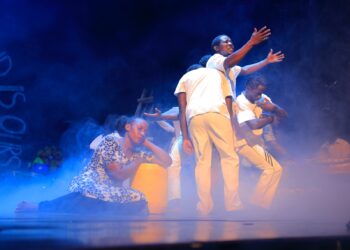
The activities kicked off at the start of March with a physical theatre workshop led by Zimbabwean theatre maker and drama lecturer Lloyd Nyikadzino. Over the three-day lab, Lloyd led participants through vigorous body and movement exercises, navigating how their bodies can carry stories without words. He further challenged them to create mini performances that were later showcased to an audience at the end of the workshop. The showcase was interactive, and the audience was invited not only to interpret the presentations by the actors but also to contribute to the creation of some skits.
“The goal of the lab was to have the actors perform truthfully without the structures they are used to, because they can be limiting. Text is just the icing,” Lloyd said, adding, “The participants were eager and passionate. They reminded me of the young actors I work with back home in Zimbabwe.”
The participants included dancers and actors at different levels in their performance careers. Gareth Ntugwerisho, a fresh graduate from the Makerere University School of Performing Arts earlier this year, was one of the participants in the workshop.
See also: Walking Into The Night To Make A Day: On Uzor Maxim Uzoatu’s A Play Of Ghosts
“In this short time, I have learned some things I didn’t study in school,” he said. “I learned how to get out of my head and trust my body to tell a story. I also learned how to be aware of my space and work in a very limited time.”

Aganza Kisaka, the president of ITI Uganda, has tirelessly worked with her team to revive the enthusiasm around theatre arts in Uganda. As the world’s largest theatre organisation with offices in over 90 countries, ITI’s presence has not always been felt in Uganda. Since taking office a year ago,
“The workshops and activities are part of the mission to rebuild the visibility of ITI in Uganda. The organisation is for all theatre artists, not just a few, and everyone is welcome to become a member,” said Aganza.
“We are focusing on theatre and dance artists because dance preserves culture and theatre preserves the stories of that culture.”
More Than Acting: The Art of Drama Therapy
Among the various activities curated by ITI was a drama therapy workshop that was hosted at the Goethe Zentrum, one of the partners of ITI for their World Theatre Day programs. Not many Ugandans are familiar with drama therapy, and that stems from the cultural attitude towards therapy itself. Drama therapy is the intentional use of drama and theatre processes to support emotional healing, personal growth, and promote mental health. The art can be used by all age groups in all scenarios, giving participants a chance to liberate and express themselves freely.
See also: Stages of Faith: Navigating Theatre and Religion in Uganda
The idea of paying a stranger to talk to about your personal struggles is frowned upon in most African communities. Therapy is further viewed as something for people who are ‘mentally unstable.’ Nonetheless, the turnout for the workshop was proof that people are becoming curious about conversations around mental health and finding alternative ways of healing outside of other forms of therapy, some of which can be very expensive and inaccessible.
The three-hour workshop was led by Rashida Namulondo, a performer, activist and applied theatre practitioner. Rashida took the participants through engaging exercises and reflections based on the ‘Routes and Roots’ theme. The participants moved through the space filled with threads, placards and sticky notes that helped them to navigate their journeys from the past to present.

“I appreciate the level of participant engagement. Participants were open to the process and highly responsive to what was unfolding, actively contributing to shaping the experience,” Rashida shared.
I had the opportunity to support Rashida with facilitating the exercises, witnessing firsthand how drama can be a tool for understanding oneself and others. My favourite exercise was ‘The Suitcase’, which required the artists to be vulnerable enough to access memories from their past that they still hold onto and how they make them feel. It was both a fascinating and delicate experience, during which some participants unlocked parts of themselves that they had not accessed in a long time.
See also: Jeannette Troupe: A Living Cultural Heritage
Participants were asked to pair up and share their stories about a time in their lives when they were forced to move or leave a place, while reserving the right not to share if they were uncomfortable. The teams were then tasked to turn the stories exchanged into short skits, which we brilliantly executed within a short time. By the end of the workshop, the performers walked away with a better sense of how drama therapy can be beneficial to their artistic work and personal lives.
Women in Ugandan Theatre
The celebrations continued with a series of talks and conferences, including the first-ever Women in Theatre conference, which explored the issues women face in theatre and how they can be addressed. The panel discussion was well represented with both veterans like Kaya Kagimu Mukasa and Eron Matovu, as well as young artists like Muhirwe Dorothy and Patience Nuwagaba, who moderated the conversation.
Among the topics that were explored was the identity of women in the arts and the stigma they face due to preconceived ideas about their work.
“Being an artist comes with being misunderstood, and it’s even worse when you are a woman,” Kaya Kagimu Mukasa said. “There’s this myth that women in the arts are loose because of the nature of the work we do and because we are forced to work late hours.”
Muhirwe Dorothy, a playwright and director who is also a new mom, talked about the challenges she faces when it comes to upholding her values as a wife and mother in relation to her career.

After graduating from drama school, she was eager to try out being an actress, and she took any roles she could get out of excitement. But over time she found herself conflicted when she had to do roles that were not aligned with her core values.
“I had to make a decision early on in my career about what I was willing to do and what I was not comfortable with,” Muhirwe said. “I ended up having to focus more on other aspects of theatremaking, which I am currently content with.”
See also: Trauma, Faith and Identity Jonathan Sasha’s Die Stoep
Guidance and mentorship of young women in theatre was another topic that came up during the conference. In the past, women in Ugandan theatre did not have many female playwrights and directors to look up to or even learn from because the theatre landscape at the time was dominated by men, especially in the 60s, 70s and 80s. Most women were actresses and singers, and very few explored the alternative aspects of the craft. Today, however, we have more women directors, playwrights and producers who are not only pushing the boundaries in theatre but are also pouring back into the new generation of female theatremakers.
Actress and playwright, Amina Naluggwa, is a protégé of renowned singer, actress and playwright, Mariam Ndagire, with whom she attended the workshop. After graduating from the Mariam Ndagire School of Performing Arts, Amina has continued working closely with her mentor to produce quality productions at Bat Valley Theatre and other venues.
“I am proud to have been mentored by Mariam Ndagire. I have learned so many things from her, not only as an individual but also as an artist,” Amina shared.
Apart from Mariam Ndagire, there are other seasoned female theatre makers, including Asiimwe Deborah Kawe, Adong Lucy Judith and Kaya Kagimu Mukasa, who mentor young women and provide training to pass on their skills. Many female artists, myself included, are beneficiaries of the generosity of these exceptional women who came before us, and the fruits of the seeds they have planted are visible.
By the end of the conference, one question that stood out from the audience was whether these structures and organisations that the established female theatre makers have set up can stand on their own in their absence. The responses were affirming.
“I am not only passing on knowledge to the younger generation. I have also created a system that is set up in such a way that if I am away or not around anymore, the Mariam Ndagire School of Performing Arts will keep running,” Mariam Ndagire stated.
See also: Emelda Ngufor Samba: Scholar and Face of Theatre Arts in Cameroon
Other ITI talks that were part of the World Theatre Day activities included discussions on Money, Grants and producing for theatre led by ITI Vice Secretary Julius Lugaaya and a conversation about Art and Faith by Duncan Kawooya, a dancer and economist. This week will be the last of the celebrations with a copyright symposium, exhibitions, performances and an awards ceremony to honour the work of outstanding Ugandan theatre makers.

The Ugandan Theatre Excellence Awards
The International Theatre Institute Uganda has also planned to hold the first of its kind, Uganda Theatre Excellence Awards, which have nominations across 10 categories with 104 nominees from 23 productions. Voting for the inaugural ceremony is judge-free, and the public is invited to vote for their best performers, directors, productions and more. From the engaging workshops, illuminating discussions and brilliant performances, ITI Uganda’s World Theatre Day celebrations remind us that theatre is not just about entertainment but is also a living archive for our journeys, struggles and dreams. The stage is both a mirror and a map with which we trace where we come from and where we are going.
Ugandan theatre is alive and is moving forward with intention, thanks to organisations like ITI, which are determined to return Ugandan theatre to its glory. The public is invited to the World Theatre Day celebrations happening at the Uganda National Theatre this Saturday, the 28th of March, from 10 am to 10 pm, where the award ceremony will also take place.



Discussion about this post