


Professor Emelda Ngufor Samba, the scholar and prolific Cameroonian theatre practitioner is perfect sample to portray the sons and daughters of Cameroon who overcome cultural taboos and societal critics to serve the community through artistic works.
I know that she is fine like success in academics!
I know that she knows that she is mummy for students in academics!
I know that people know that strength and power come from impacting knowledge!
I know that her present might is the perfect flag to establish continuous knowledge!
Bam! Bam! Bam!
Emelda Ngufor Samba’s Early Career
Say Boom! Boom…
Say Boom! Boom…
During her school days at University of Yaoundé I, Samba was privileged to be trained and work with Bole Butake and Gilbert Doho, who at the time (80s and 90s) were the most prominent theatre practitioners in Cameroon. She performed in some of the most successful plays taking for example, the lead role of Ojouala in like Ola Rotimi’s The Gods are not to blame directed by Bole Butake and his (Butake) semi-historical play Zintgraff and the battle of Mankon and many more.
At a tender age, as a school pupil, the world had identified a star in Samba. For the saying goes; thus, adults have a way to identify talents in children. Is it not true that adults will always observe the attitudes and movements of kids? And when they identify a special talent on these kids, do they not nurture their talents and encourage the kids to showcase these skills to the world? It all started when Samba was a girl in Sunday school, and she was always called upon to perform roles during Sunday school rallies with the young Presbyterians.
See also: Stories and Sisters: The LAM Sisterhood
In primary school her teachers could tell that there was something in her. On their graduation day, she played the title role of Njema in the play, Njema written by Musinga Elame Victor in 1984. That flair of art in her continued in secondary school as she joined the drama club at Government High School (GHS), Kumbo. This flame continued when at university she joined the “Le Théâtre Universitaire’ (University Theatre) a student club created by a French actor, Jacqueline Leloup. Year later, when Leloup left, leadership of the club was taken over by Bole Butake and Gilbert Doho; the two people who further nurtured her talent and prepared her professionally.

Her passage in the university theatre was enriching because she embraced diverse and versatile training, technics, and managerial skills from the two directors who practiced different directorial styles like Bole Butake, who was more into realism and Gilbert Doho into the French declamatory way of performing. This rich cultural and linguistic background would yield fruits years after.
Bam! Bam! Bam!
Emelda Ngufor Samba and Theatre practice in Cameroon
Emelda Ngufor Samba has been teaching and practicing theatre for the past decades and her work can speak for itself through her trainees who are now accomplished practicing professional artists themselves.
“I like to teach, I like to see people grow so each time I teach be it English language be it literature or theatre and I see that change in someone from the point of not knowing to the point of acquiring more knowledge, I have a lot of satisfaction from that and I want to say that I have really had that kind of satisfaction when students come to me years after and they tell me I am this because of what you thought me, I am able to speak in public because of the training I received from you during our acting classes, I am able to direct a play because I observed you as director or I worked with you as a stage manager. So, I have that kind of satisfaction knowing that I bring positive change in the life of people.” Artist and academician, Professor Samba, says candidly when I meet her for this article.
Theatre practices in Cameroon like in every African country emanated from socio-cultural practices of veneration to the gods and ancestors and in need for solutions in times of hardship through rites and rituals during ceremonials. The uniqueness of their performances was in mnemonic, body language, rituals, and audience participation through mime, dance, song etc.
See also: The Women Making Waves in Theatre in Africa Part 1
As time elapsed, and with the advent of colonisation and its policy of cultural assimilation through explorations and missionary movements, theatre practitioners turned to plays that did not depict their identities but rather those of the westerners. After the independence of most African countries, the paradigm changed.
The dreams of most African people were shattered. Fellow Africans lived another form of colonialism and this time perpetrated by their fellow brethren. The worrying questions on corruption, banditry, capital flights, exploitation and marginalisation were the order of the day that led to a lot of unanswered questions pondered upon by the likes of Wole Soyinka, Ngũgĩ wa Thiong’o, Bole Butake and a host of other African, who picked their pens and conceived artistic works as a means of expression and discussion of post-colonial malice.
Today, new directors and writers talk about their different topics.
According to Samba, art/theatre has greatly evolved over the years. Contemporaries try their hand in diverse themes, new directors are concerned with the gender issues, political issues, and diverse topics. They are more exploratory; they are more experimental with binary kind of performances where you have a performance on stage and a recording of some scenes being projected and this is because of the kind of audiences that we have now. People are so prone to the screens and their telephones. So technologically, there has been some change in the development and evolution because artists are being more and more experimental.

Despite continuous experimentation in theatre practice in Cameroon, a greater part of the practitioners do what Samba considers Poor Theatre. Not the type practiced by Jerzy Grotowski who talked of poor theatre like art that does not necessarily need light, sound, costumes, set design and at times with little dialogue but should be concentrated on the actor’s body, voice and facial expression. The concept of poor theatre in Cameroon is typically because of the poor economic situations, where with little or no financial resources, more and more, artists fall back to Poor Theatre, making use of less stage props, less stage décor.
See also: Nambi: A Salute to Womanhood
This new wave of theatre practitioners includes Martin Ambara, the theatre director and owner of a theatre laboratory called Othni, Hermine Yollo the director of la compagnie Ngoti, Ousmanou Sali of Zouria theatre, Ade Joseph of the Ideal Theatre Troupe, Landry Nguesta of Emintha, Wirsiy Bernard of Rainbow Interactive, Junior Esseba of Theatre et Folie and many others whom despite the challenges faced in the art sector in Cameroon, they continue to produce and direct plays for the community.
Bam! Bam! Bam!
Emelda Ngufor Samba’s Theatre Practice and A Successful Artistic Career
Story story! Tell us a story
Story story! Tell us a story
Say Ibani! (Ibani)
Say Ibani! (Ibani)
Mighty 2012, a year where the audience at the Goethe Institut Cameroon waited with anticipation to watch another play of Samba. At 7pm the lady in green entered the stage and danced, and danced, and smiled at the excited audience. Then, the lady in red, the lady in blue, the lady in purple! And all the ladies climbed on the stage and danced, danced, and smiled at the excited audience. It was the famous 1975 play, For Colored Girls Who Have Considered Suicide/When the Rainbow is Enuf, by the African American, Ntozake Shange. The actresses on stage mesmerised with their dancing steps, their poetry and sorrowful monologues that penetrated deep into our hearts and left us speechless.
Then the director of the play, Samba climbed on stage, held her mic and cried. She could not talk for some time. We knew that her tears were those of joy, fulfilment, and peace. She had successfully acclaimed her title as one of the best female directors of Cameroon.
I still remember how the audience stayed glued to their seats with sparkling eyes on stage and mouths opened, ready to smile, laugh and wonder each time Samba, would tighten her loincloth wrapped around and under her armpit. She slowly bent centre stage and took her small five-litre empty plastic container, rose and with a subtle sweet voice said “Say Ibani” and a loud crowd replied “Ibani” with voices full of laughter. She walked with attitude around the stage, giving her back to the audience, turned, gazed at her beautiful loincloth and with the tick of the eye lid said happily and aloud “Say Ibani”. Once again with joy the crowd replied “Ibani”. It was the International Day of Storytelling in 2019, held at the Cameroon Cultural Centre. Many storytellers from Cameroon performed that day, but it was Samba with whom the audience were mesmerised and applauded.

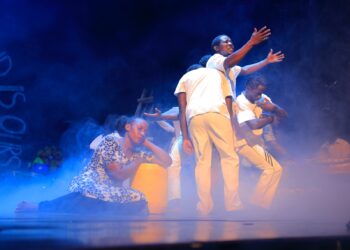
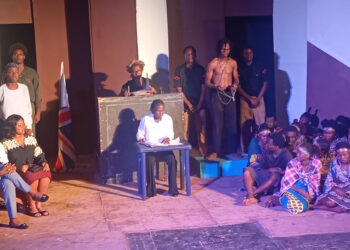
Years later she continues to direct and produce plays for the community like I rather die than live (1989) a play on environmental protection written by Alice Tata. Changing Tides, which she wrote in 2021 and produced a multitude of times. As her trainee I was fortunate to direct the first performance in May 2021 at Hotel Fibi, in June 2021 at the Amphi 300 of the University of Yaoundé I.
The following year in March 2022, under the framework of the World theatre day organized by the Cameroonian Ministry of Arts and Culture, it was performed at the Cameroon Cultural Centre (CCC) and in May 2022, at the Cameroon French Institute (IFC) under the framework of Rencontre Theatrale Universitaire, a program piloted by Francis Tami Yoba, a Cameroonian writer, actor, and director in partnership with IFC.
Bam! Bam! Bam!
Emelda Ngufor Samba: Instructor, Researcher and Practitioner
Today, Emelda Ngufor Samba, is present in the lives of the communal people of the interior parts of Cameroon. She is engaged in many humanitarian activities in community development. She is lead for Disability and Inclusion African Network. A Network that involves 4 countries with lead from England. Researchers from 4 countries (England, Cameroon, South Africa, Nigeria) Researchers from these countries created a network on disability with main idea to improve the situation of people living in disability. In December 2023, she organized a one-day workshop to commemorate the International Day of People living with disability at the campus of the University of Yaoundé I.
See also: The Women Making Waves in Theatre in Africa Part 2
Samba’s research is interested in different methods for applied theatre in communities. She has published on the subject interrogating the methodology. Samba is also interested in the contribution and limitations of women in theatre for development. The research has enabled her to make great discoveries in different cultures, perceptions of life and artistic approaches and practices in solving communal issues.
For years, Samba has been teaching and performing inside the classroom and theatre halls, and in the community. Her work in the community engages people on issues like HIV/Aids and recently, disability and inclusion. The professor has facilitated theatre for development projects for the university and most recently UNESCO.
Today Emelda Ngufor Samba is the head of Section for Performing Arts and Cinematography at the University of Yaoundé I. As a lead lecturer she makes sure students are comfortable with every teacher and that they are normally taught. Good at identifying talents and knowledge, she will encourage all her students to be responsible and professional youths. During lectures she always reminds her students to go look for sponsorship, to talk about their art to friends and the public, to learn how to develop projects for sponsorship and partnership.
I should know. I have gone through her mentorship.



Discussion about this post