


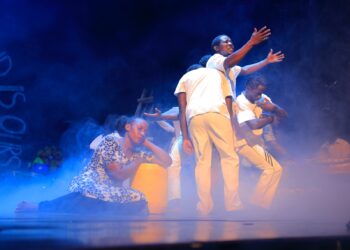
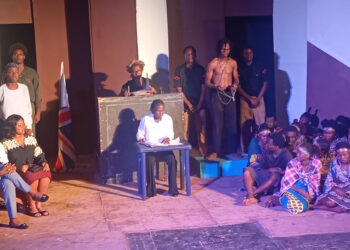
When Keamogetsi Joseph Molapong took to the stage of the National Theatre of Namibia with his latest directorial effort, God of Women, audiences were introduced to a theatrical exploration of identity, culture, and resilience. The play writen by Sifiso Nyathi boldly asked, “What happens when two vastly different cultures collide? Can traditions withstand the forces of globalisation, or do they inevitably change?” These questions do not live in the abstract for Molapong, they are the threads that define his decades-long journey as a poet, cultural worker, and now, director.
Molapong has been immersed in the world of words since 1990. He began carving a place for himself in Namibian literature at a time when the country was newly independent and navigating the rebirth of its cultural voice. By 1992, he was already shaping platforms for others, helping to establish Ama Poets, one of the first collectives in Windhoek dedicated to nurturing poetic voices. Four years later,1996, he co-founded Kitso Poets, continuing his mission of creating spaces for dialogue, self-expression, and performance.
See also: Jeannette Troupe: A Living Cultural Heritage
From these beginnings, Molapong steadily built a body of work that blended his love for poetry with community activism. His contributions to the anthology; We Opened The Door And Saw Ourselves (New Namibia Books, 1998) reflected a generation finding its post-colonial footing. Soon after, he staged performances like, The Black People I Know and The Scars on My Skin Part 1, both of which fused theatre and poetry in ways that foreshadowed his later theatrical direction.
At the center of Molapong’s creative journey is Township Productions, the company he founded to amplify Namibian voices. Through it, he has organised regional poetry festivals, high school competitions, and published series such as Poetree. His pen has been equally busy, producing collections like Poetically Speaking (2000), Come Talk Your Heart (2005), In Search of Questions (2005), and The Scars On My Skin (2014). His more recent works include; A Poem to the President (2020), When Words Are Few (2020), and The Heartbeat of Pain (2022).
Molapong’s work has not stopped at Namibia’s borders. His poetry has traveled to international anthologies like No Serenity Here (2010), which was translated into Chinese, and Afrika im Gedicht (2015). He has performed at major festivals in South Africa, Germany, Botswana, Russia and Colombia.

Beyond his personal output, Molapong has been relentless in lifting up other writers. Through Township Productions, he has edited and mentored younger poets and his collaborations with academics and writers show his openness to dialogue between disciplines and voices.
Perhaps most telling of his vision is his work in building traditions where none existed. He was instrumental in launching World Poetry Month in Namibia, with four successful editions by 2017.
All of these experiences have culminated into God of Women, written by Professor Sifiso Nyathi. While theatre is often seen as distinct from poetry, for Molapong the two are natural extensions of one another, “Both art forms demand rhythm, emotion, and embodiment”, he says. His poetic sensibilities inform his direction, shaping performances that are layered in metaphor and unflinching in theme. In God of Women, Molapong uses the stage as a battleground of ideas, where globalisation challenges traditions, and where women’s strength emerges as both timeless and urgently necessary.
See also: Ashwyn Mberi: Connection Through Storytelling
As he looks toward the future, with his forthcoming collection, Dressings the Crosses, set for publication in 2025, Molapong shows no sign of slowing down. His career reflects a rare balance: a poet deeply committed to his own craft, and equally devoted to building platforms for others. Whether through print, performance or now, theatre. His work continues to ask difficult questions about who we are, how we change, and what we hold onto.
In meeting the director behind God of Women, one finds not only a poet turned theatre-maker but a cultural architect who has spent more than three decades weaving together Namibia’s literary and performance landscape. For Molapong, art has always been about more than personal expression; it is about community, resilience, and the ever-shifting dance between tradition and change.



Discussion about this post