


Pierced is the familiar tale of a man who unable to withstand the loss of his lover goes after the lover’s new man. What elevates the story though is what Innocent Chisom Valentine, the solo actor of this play, brings with him to the stage, under the directorial efforts of Emenike Victor. Innocent is a terrific actor and in the hands of the experienced auteur, he ruled the nights on 14th and 15th March when the play was staged at the Arts Theatre, University of Nigeria Nsukka.
Hell hath no fury like a woman scorned, so goes the popular proverb adapted from William Congreve’s The Mourning Bride, but what happens when it is a man scorned? What happens when a man’s love is unreciprocated, jilted—when his heart is pierced by the knife of rejection? Emenike Victor’s Pierced is a play that performs the fury that comes with such a situation.
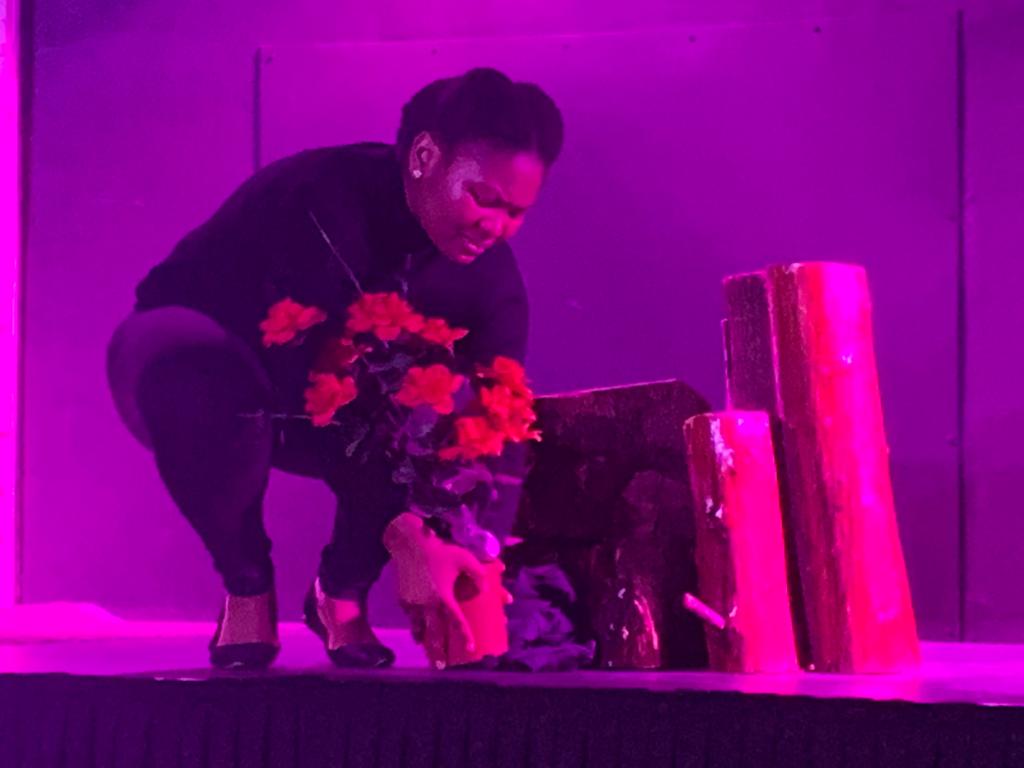
The stage opens to a bare space, save for a single bunk, a door by the corner left open to show a toilet seat, a telephone and a mirror placed at two extremes. The walls wear a depressing navy blue. In the centre, as if springing forth, a drawing of a white skull. If you are still confused about where exactly this is, it is a prison room. Here, death reigns. And occupying this room in his orange cover-all and white flip-flop is Innocent, a man who has brought death to another.
See also: Rope: Celebrating Women, Theatre and the Search for the Truth
“Am I a killer?” Innocent asks. “Of course, not,” he answers himself. “I’m Innocent.” In that witty way, Innocent introduces himself to the audience by name, while simultaneously playing with the idea that he is not really guilty for the crime of which he convicted. True, he may have stabbed someone in the heart, leading to the person’s death, but more things have gone through his heart on two occasions, a fault his victim is culpable of.
Innocent begins his story in 2015, the year he was admitted to the University of Nigeria, Nsukka. His journey to his prison room can be traced to the first day he stepped into the university campus. “Lo and behold, the first thing I set my eyes on was the backside of a lady.” It is instructive that a student stepping into the university for the first time sets his eyes firstly on the “backside of a lady.” Of course, that may not be the first thing he sees immediately he enters the school gate, but that is the first thing he sets his eyes on, the first prominent thing he actually sees.
At this point it becomes clear that Innocent is one for whom the ladies is a big temptation, maybe even a distraction. While removing his focus from the lady, he rebukes himself and swears never to allow himself be distracted, and only focus on his studies and developing his other talents. An oath he mostly keeps until Ifunanya enters the picture after his first year.
See also: The Thenx Ladies: Creating and Celebrating Truth
Ifunanya is an Igbo word that means love. Emenike Victor’s onomastics in the play is quite an interesting one that deserves some analysis. By naming the guilty prisoner Innocent, he provides the prisoner the opportunity to claim he is innocent, without it being a lie. When he refuses to address himself as a killer stating that he is innocent, it is in part an agential undertaking of refusing to be marked by a crime, even if it is yours, insisting to be called by your name. By making Innocent’s lover “Love,” and her entrance cum exit from Innocent’s life a destabilising event, Victor makes Ifunanya transcend being just a character to being also an idea—the occurrences following her his critique of love, especially when used in the romantic sense. In this sense, there is always a thin line between love as a desired attribute, and hatred. Congreve’s Zara in The Mourning Bride comes to mind again. This time, the first part of her popular “hell hath no fury like a woman scorned” quote: “Heaven has no rage like love to hatred turned.”
Ifunanya as an Igbo word when translated literally means “to see (with the eyes).” This draws back to the question of sight and how it affects Innocent, how it distracts him. Innocent’s first problem upon entering the university campus is that of sight and Victor’s decision to name his lover a name that calls to mind the issue of sight foretells that Innocent’s first act of seeing will result in his undoing; that despite what he has led himself to believe, he is not yet free from what the sight of ladies brings upon him.
When Innocent sees Ifunanya, he recalibrates his goal as a student. (What does it mean for him to spend time doing his own assignments when Ifunanya needs someone to do hers?, he wonders and concludes Ifunanya’s wants must always come before his needs.) It is at this moment we realise why the mirror, an uncommon sight in a normal prison room, is there with him. With it he re-enacts the time he spends on the mirror, trying to see if he is dressed enough to capture Ifunanya’s gaze and by the time she starts coming to him to borrow his things, he becomes convinced that he has not only captured her gaze but also her heart. Ifunanya now sees him, he believes, and off he goes hunting for advice on how to make sure Ifunanya never stops seeing him.
See also: YDC Theatre Calls for Investment in Children
A former presidential candidate of Nigeria once confessed to having been advised by a madman. His exact words, “I got the advice from a madman,” are now used in multiple skits, mostly in contexts that show stupid acts because what advice can come from a madman that will not be a mad advice? (which sharply deviates from the context this presidential candidate had used it—he had tried to show that one should never look down on anyone as even a mad person once gave him a valuable advice). In his search for advice, Innocent meets his own madman in Fresh, the stereotypical figure of a smoker, good-for-nothing, university loafer. Fresh gives him an advice that costs him not just his money but also his love. Which is another way of saying that Fresh’s advice for him to get Ifunanya an expensive gift helps him see that in his relationship with Ifunanya, he is the only one dating. Fresh’s advice helps shatter his assumptions and illusions. Ifunanya sees him, he finds out, but like “a brother I’ve always wished for.”

The cliché follows: “those words pierced my heart like an arrow.” Here, we have our first act of piercing, one that will beget two more, the last literal. This is where Innocent also introduces us to the music maestro, Richard, known as Mr. Idea, for his wonderful ideas.
Richard is not only talented in music, but also in how to spot and grow (with) other creatives. Richard has in class observed that Innocent has the talent to effortlessly make people laugh. He sees as a latent talent that can make Innocent into a well-known comedian and compère. His idea on how to make this happen comes at a perfect time as it not only helps Innocent to build the talent he has always known he possesses, but also help him to get over his sour love affair, at least for the main time. With time, Innocent grows to be known throughout the university campus and even beyond with Richard as his manager. His career is booming towards the end of his university days. With few months left untill his graduation, he looks forward to taking his craft to bigger stages outside the university campus. But he also remembers Ifunanya.
See also: Miangaly Theatre Company: Defining the Stage in Madagascar
This remembrance is like him fetching another arrow with which he will be pierced. Not only does he confirm, as a note of finality, that his love for Ifunanya cannot be reciprocated, he also discovers that the one who came to take him away from his sorrowful life without Ifunanya also took Ifunanya with him. He charges to confront Richard and there, the second arrow pierces his heart, as verbal missiles. Richard tells him to grow up and not charge around confronting people over a love affair that ended years ago – quite sound advice. But Innocent’s reaction is to pull a knife and Richard who maintains Innocent is a coward dares him to use the knife if he is strong enough to. Here, Richard disregards the Igbo proverb that goes “A sịkwana nwata na o nweghị ihe ọ ga-emenwu,” for truly when you dare a man to do his worst, that worst may be unimaginable.
Innocent Chisom Valentine’s acting merges reality and fiction and that proves to be the apex of the production’s strengths (and also its weakness). Not only does he retain his name as a character, like his character, he is also a comedian and compère who achieved fame in a university campus at… you guessed it, University of Nigeria, Nsukka. This marriage of his real life and the fictional character’s makes it possible for Innocent not to act but to just be himself (and when he does act he is still himself because Innocent is an actor!).
That he plays himself in most part of the play, as already stated, is both a blessing and a curse to him. It is in this life performance aspect that it becomes a curse. When he jumps onto the stage (literally, as he also has to jump the toilet seat to re-enter the stage) dressed in the compère suit, he brings with him a spirited performance as a funny and witty host. This he pushes to its sad extreme when he transitions to his comedian aspect and tries to freestyle a stand-up using what he can see in the audience. Most of the jokes fall flat, muds randomly flung at the wall refusing to stick. At the end of the day, he resorts to the low-hanging fruits of discipline, gender and body (Pharmacy girls marry in their penultimate years, Art girls start hanging around hotels in the same year; fine girl brings her facially less endowed “toaster” as one of our primate cousins specimens to her science practical class). Luckily for everyone, these low moment does not exceed ten minutes.
See also: Translating the Act: Kenyan Producers Keeping Indigenous Languages in Auditoriums
When he dons the orange cover-all, or wears his compère suit, his actions accentuate the beauty of the work of the costumier, Bangkok Apparels. Even though their costumes alone, with Abanobi Emmanuel’s makeup, are enough to pass the auteur’s messages, Innocent’s stagecraft brings these messages to life. He is at his best though when he is dancing or merely reacting to Canice Igwenagu’s music.
Igwenagu’s score set deserves a special praise. Whether he is playing the songs composed specifically for the production, or other popular songs that suit the mood of the play, what is constant is the almost compulsive drive to leap off from the chair and dance. This, luckily for the viewer, is vicariously achieved in the dance steps of Innocent, an all-round performer, who Azubuike John Nwachukwu does not fail to always keep in proper lighting.
Mark Chijioke Ugwoke’s almost perfect set is spoilt by one error, his choice of the exit. The door left opens to show a toilet seat, completing the image of a prison room, later in the play serves also as an exit. Imagine the actor jumping over a water cistern seat in order to leave the stage. And that is exactly what happens!
Pierced is less about the story – which is a basic cliché one – and more of a celebration of the theatrical gift that is Innocent Chisom Valentine. It is a display of what young people can achieve when they come together to produce a play. The collaboration between Innocent Chisom Valentine (both as the solo actor and the producer), Tunechi Udomba (as the production manager), Emenike Victor (writer and director) and Favour Ifunanyachukwu Okeke (as the stage manager) is itself a testament to the future of Nigerian theatre in the hands of the young ones.
The production of Pierced beyond its aims succeeds at piercing through the somewhat depressing cloud hovering over Nigerian theatre and reveals the silver lining. Here, the power of one is shown as for two hours a single actor strutted the stage alone and still held the audience attentive, spurring them into active participation.



Discussion about this post