


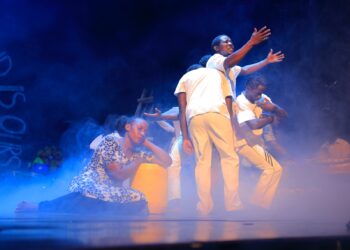
Moses Tumwebaze is a full-time actor in the Ugandan Theatre industry. He is a member of The Ebonies, one of the few operational theatre companies in the country, who ply their trade at Theatre La Bonita (another one-of-the-few things) in the capital, Kampala. Like most theatre practitioners, Tumwebaze last stepped on stage around March in Big Jimmy, a show they had before the lockdown. ‘At first we hoped that theatres will reopen in three months,’ says Tumwebaze.
As Tumwebaze relates this, with a tinge of nostalgia for stage, felt on the other end of the line, my mind (quite a stubborn servant for attention) strays to Chinua Achebe: When suffering knocks at your door and you say there is no seat for him, he tells you not to worry because he has brought his own stool. I am no palmist nor futurologist, but the pandemic seems not to be in any hurry. Could it have come with its own stool? (Take a deep breath and read your palm.)
See also: Angella Emurwon: Writing for Me Is like Breathing
When the New Normal Is Abnormal!
At the eve of the lockdown, Vicent Jjingo, another Ugandan theatre actor and the director of Mebo Theatre and Documentaries Limited, was running a children’s theatre programme and a production of Semitego, a play on the Luganda ‘A’ level syllabus in Uganda. ‘Our work is mostly done in schools. With the double closure of schools and theatres, it is hard to earn a living, pay actors and hold everything together,’ Jjingo, who has now taken to farming and writing, confesses.
Tumwebaze and Jjingo may be quite lucky to find occupation and means to survive in these hard times, but many actors and other artists, particularly freelancers and members from smaller groups, are finding it hard to make ends meet, even though most of them do theatre as a part-time job.
In an industry with dysfunctional organisations such as actors guilds and welfare unions, the pandemic is having a bitter toll on the everyday artist, sucking his emotional energy out. Non-conventional artists such as itinerant performers, clowns, jesters and puppeteers seem to be the most hit hard. Before Covid-19 broke out, it was not unsual to find a Dikuula or Omufuusa (as some non-conventional artists are often called among the locals) in village squares, small towns or Kampala slums with hordes of spectators and by-standers around them. Not that they collect much money from their audiences. Their pay is actually a voluntary penny or two from an onlooker and how deep their act bores into the sympathetic regions of a viewer’s heart, but Covid-19 has jealously robbed them of those little earnings.
See also: The Shopping Dead: A New Theatrical Sensation on WhatsApp
While theatre artists are coping with the new normal, going virtual and thinking standard operating procedures like social distancing in theatres in light of how long it may take to wipe out the virus, Tumwebaze is skeptical about these new developments for theatre: ‘For music, you may assemble instruments and put up an online show. But for theatre you cannot have a successful online show or a socially-distanced act. Unless you’re doing a monologue.’ Theatre is a highly interactive art, and Tumwebaze is aware of not only this sociability but also the principal facet upon which theatre is built: the interaction of actors and actors, actors and audience, and audience and audience. Nevertheless, Tumwebaze has opened up a YouTube channel and started to produce short comedy skits.
Virtual or Physical Theatre?
The number of YouTube and other virtual spaces opened up by theatre artists in the pandemic is more than the viewers and subscribers themselves, but necessity is the mother of invention and this is one way artists can remain in touch with their audiences and document theatre for posterity. Uganda National Cultural Centre (UNCC) recently opened a YouTube channel to play some of the recorded past Ugandan theatre productions to their online audience.
The culpability of digital theatre lies in more than being devoid of the aesthetic, psychological and physical experience that theatre as we know it gives. That sensuous, total world created by actors on stage in which they let audiences actively take part. Without even alluding to the technical and technology challenges that come with virtual performances, the message is often lost in transmission.
See also: The Tragedy of Social Distancing in Physical Theatre
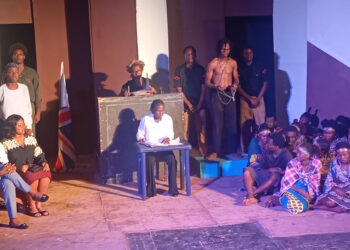
Dr Richard Kagolobya is a theatre arts lecturer at Makerere University’s Department of Performing Arts and Film. Kagolobya who, in 2008, directed Phillip Luswata’s Crazy Storms, recently relayed by UNCC for YouTube audiences says electronic and online audiences lose ‘living the moment and the naturalness that comes with theatre’. In reference to Crazy Storms, the video production does not capture the sound effects of rain and thunderstorm characteristic of the original theatrical production. The poor lighting in the video loses out on costuming too. The mood, the stage and the facial expressions are also cut and constrained by the videographer’s choice of frames and shots.
In short, video productions of theatre tell a different story as seen in the eyes of a different artist. This makes theatre irresistibly superior to other art forms and remains its defining moment and resilience in the face of human tragedies and plagues. (Can I see someone kiss their palms and say amen?)
See also: Joburg Theatre Stages Zakes Mda’s Dead End as First Production with a Live Audience
What Next?
UNCC as an organisation charged with the mandate of overseeing, preserving and promoting arts and culture in Uganda (including theatre) has also organised a couple of online talk shows and workshops and distributed modest Covid relief in terms of food items to artists registered with them. It remains to be seen if there is a relief fund that UNCC and its line Government ministry have set up to support Ugandan theatre artists at a more sustainable level.
The pandemic, very un-African, very un-theatre, considering its alteration of our communal lives, could have come with its own stool. Until the world turns that stool over, the Ugandan theatre practitioners have two pandemics to deal with – the pandemic itself and the pandemic of remaining alive in the pandemic.



Discussion about this post