


Remi, the protagonist of The Black Hermit, is a man “reared” by the tribe, who has returned from where he was sent to acquire “big education” to “break” the tribe, rather than lead her to victory as the elders envisioned. But Remi is not an ingrate, he is never one who turns against his people—except when turning to his people means disaster to the postcolonial nation whose soul he has fought for its existence. Remi’s decision to abandon the tribe and go live in the city as a hermit and his later decision to return to break the tribe comes from his rejection of tribalism, which the elders prop as the only means of gaining victory for the tribe.
For the elders, “Through his big education/He [Remi] would have bound us together./He should have formed a political party,/And led us to victory.” While this seems to be an innocent ambition of a people who want to actively get involved in how they are governed, the tribalistic nature of this ambition becomes clear when the leader of the tribe says, “Not one of our skin and blood/Is in the new government.” It is telling that the leader and the elders of the Marua tribe are of the opinion that what they need in the post-colonial government ushered in by Uhuru is not a good leader but “one of our skin and blood.”
While Remi himself upon return from his self-imposed hermitage used “wrathful words” against the elders and leaders of the tribe in what his patriotic friend, Omange, refers to as “deal[ing] with tribalism with ruthless vigour,” there is a sense in which the tribal leaders are not so much tribalistic as they are merely trying to defend the Self, the Self here being the tribe (and Remi would later realise how central the preservation of the Self is to the preservation of the nation).
See also: “Time Trips Tyrants”: Failed Leadership and Violent Revolution in Esiaba Irobi’s Nwokedi
Given the evils and dehumanising nature of colonialism that the Marua people/tribe witnessed, their hopes and expectations in Uhuru and what it will bring are high. The tribe looked forward to the exit of the white men, believing that the white men will go with all the troubles of the land which they believe (rightly or wrongly so) came with them. The tribe therefore was ready to play their own part in ensuring the coming of Uhuru. They all became registered members of the Africanist Party because their son Remi, “the only educated man in all the land,” told them that there lies their liberation. They fought the white man when Remi said so, making this educated member of the tribe their unofficial leader. They are genuinely shocked, therefore, to discover that even after the white man has gone, that Uhuru is not as beautiful as they had been led to believe.
“What has Uhuru brought us?” the leader of the tribe asked. When someone answered “nothing,” the leader is quick to remind his people that nothing is not the answer: “Not nothing. It [Uhuru] has brought us heavier and heavier taxation. We are told about roads, about hospitals; but which hungry man wants a road?” The post-independence nation cares not about the people’s needs. Rather, it engages in bogus and elephantine projects designed to fill the coffers of the rulers (and this then trickles down to the immediate tribes of these political rulers). While the people are hungry, the rulers of the post-colonial nation are only interested in building roads—and one must not pretend that these roads are of any desirable quality—even when such amenities mean nothing to a hungry person.
See also: Jeannette Troupe: A Living Cultural Heritage
The Uhuru which they had fought and hoped for arrives then as a nightmare. Teachers starve “while ministers and their permanent secretaries fatten on bribes and inflated salaries.” The only option for the educated in the city seems to be “working for these oil companies that have invaded our country.” Even a Christian leader, the pastor whose church, a visible remnant of colonialism, is viewed by the elders as one of the deceptive structures put in place by the white men, acknowledges that “Uhuru has come,/Bringing [with it] new problems.” It is not clear if this pastor thinks that a return to the pre-uhuru era is a better option, or if he even condemns colonialism. What is clear is that he too wants Remi, an educated “young blood,” to come lead “Christ’s Church.”
Having been disillusioned by the post-independence nation, the elders driven by a sense of self-preservation have no other option but to fall back to the tribe—to become tribalistic. The nepotistic nature of the post-independence nation is clear to them and the only way to gain from nepotism is to have someone of your own “skin and blood” in the new government, and who knows, your own “share” of the national spoils trickles down to you. It is this self-preservation that drives the tribal[istic] elders.
Remi and his friend, Omange, being themselves educated, seem to understand the situation better than the others, even when they disagree on the nature of the solutions that are needed. Omange, for example, recognises that “independence has not reduced the amount of racial tension,” and that—and this is important—“even a black man’s government can go wrong.” Remi believes because of the differences in the nature of the problems posed by independence to that of the colonial days, the “destructive” approach used by the nationalist revolutionaries whose “aim was to discredit the colonial power in the eyes of the people” must be abandoned, and the “opposition” mentality rejected. In essence, Remi in the corners of the room where he has turned himself a hermit advocates not really for an independent nation, but for an interdependent nation, realising that what is needed to survive in the post-independence nation is a mutual inter-dependence of the tribes, that itself having been made possible by independence.
See also: Community Theatre Is Not Amateurish – Rashida Namulondo
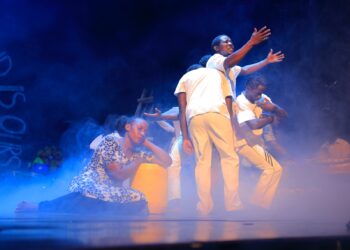
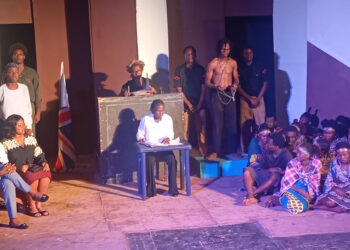
Remi’s position in The Black Hermit seems to be what the author, Ngugi Wa Thiong’o wants to present to his readers as the way out of the conundrum African post-colonies face. The play was first produced in November, 1962 by The Makerere College Students Dramatic Society at the Uganda National Theatre. Many African countries had just received their independence. Nigeria, for example, was two years old as an independent country, four years away from her first military coup and five years away from a civil war at the time of this first production.
Thiong’o’s advocacy for an interdependent existence as the solution to the troubles of the postcolonial nation is seen in the interpersonal relationships between Nyobi, Remi’s mother, and Thoni, Remi’s wife. While Thoni refuses to remarry after Remi abandoned her in the village—“I cannot now go to a third husband/I cannot roll from hand to hand…”—Nyobi, her mother-in-law, encourages her to put behind the disappointments of the past and not waste her maidenhood. Even though she is as sad as Thoni over Remi’s absence, Nyobi does not want such sadness to wear Thoni down. By seeing herself as Thoni’s mother “in all ways but birth,” she displays the maternal instinct to protect. This is a picture different from the common scenario where wives and their mother-in-laws are perpetually enemies. United by the shared disaster of Remi’s absence, the two women draw strength from each other.
This is what Ngugi Wa Thiong’o envisions for Africa; an Africa where the different African countries, united firstly by a shared African heritage, and then by the shared tragedy of colonialism, draw strength from one another as interdependent nations of one nation. To be interdependent, one must be fully independent; to save the tribe, one must have saved the Self. This is the key lesson that Remi only learns over the corpse of his wife, Thoni. In pursuit of his utopian nation, he neglects his family and tribe.. For Remi, selflessness is achieved by a total disregard of the Self. The reality, however, remains that it is an aggregation of troubled Selves that produces a troubled society. His ignorance of this makes his mother lament that “education and big learning has taught him nothing.” This same voice of motherly wisdom goes on to tell Remi that “everything is not tribe and custom./ Your mother, your wife or child are not merely tribe.”
See also: Senga Brockerhoff’s Every Woman: An Ode to Modern Womanhood
Remi recalls Irobi’s Nwokedi, another revolutionary fighting a corrupt government in the post-colony. While Nwokedi’s messianism is mostly self-imposed, Remi is made a messiah by his tribe. Both of them though are failed revolutionaries for they both ignore fixing the Self. Nwokedi becomes indistinguishable from the monsters he fights while Remi ends up lamenting, “I came back to break Tribe and Custom,/ Instead, I’ve broken you [Thoni] and me.” Both plays may, therefore, be read as a handbook to activists and revolutionaries.
Beyond the message of fixing the Self being primary to being able to fix the Other, both plays, by these brilliant playwrights, themselves revolutionaries in their own rights, point out that while the individual is very important in the fight against the undesirables, it is only to the extent that they can recruit and motivate the collective. To paraphrase an Igbo proverb, the collective always effortlessly finishes a meal prepared by an individual, regardless of the size, but the individual to finish a meal prepared by the collective is yet to be seen.
Art work: Admire at the distance…collage…oils on board by @Ronexarts 2025



Discussion about this post