


Like the title states, Abuchi Modilim’s 2023 play, The Brigadiers of A Mad Tribe, exposes how a “mad republic” operates. The events that take place in the play are as annoying as they are amusing, as exciting as they are depressing, absurd and disappointing. Nothing new is said here, however old and existing rots are freshly looked upon, reinforcing what every observant person already knows about Nigeria, and indeed many postcolonial states: colonialism is still alive and ongoing. Unfortunately, this time around, it is the supposedly free people who are running to the colonial masters begging to be recolonised, in essence, to be re-enslaved.
The Mad Tribe
Through the characters of three underpaid secondary school teachers, Modilim exposes how economic and financial hardship can lead a people to undermining their existence as a collective. In the face of hunger, the sort of dignity preached by the pan-Africanists, such as Ojukwu, becomes undesirable and unattainable. In the struggle to survive, the hardships induced on a people by their elected mis-rulers through the terrible policies and laws they put in place, the people look to the West for a messiah who must be entertained enough to want to have them over to his place. They are determined to provide that adequate entertainment, even if it means admitting they are witches and playing the part.
See also: “We want a new god”: On Ahmed Yerima’s Odenigbo
While the three teachers—Osondu, Jideofor and Ifenna—are all university graduates, what becomes immediately clear is that their teaching jobs are merely a case of the available becoming desirable because the desirable is not available. This is central to the narrative of the play and the society in which it is set. Teaching is an undesirable occupation because it is underpaid. The graduates who end up teaching do so to manage till, hopefully, they get a better paying job. Even though the three teachers have Ojukwu, himself a professor of African Studies, as their mentor, his advice means almost nothing to them in the face of a project that promises to make them rich beyond their imaginations, even if to the detriment of their society.
Organised by The Phoenix Black Science Organisation of Britain, The Phoenix Black Science Technology Prize project seeks to build a “Cloud facility for the brains of dead people” based on African mysticism, a sort of “jujunating technology.” This requires the presence of African witches and wizards and others with spiritual powers. To recruit such people, the prize is instituted to award 100,000 pounds with an all-expense paid trip to England to any group of witches and wizards who entertains the organisers the most with their spiritual powers.
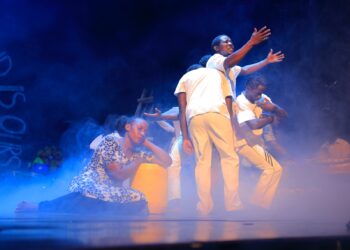
The teachers recruit Ekemma, Obichikalu and Chikelumma, members of different secret spiritual societies and custodians of shrines, and Echeuwa, a self-proclaimed witch, to form their own group, The Brigadiers Order. Amanda, an American professor of Robotics Engineering and Ojukwu’s lover would later join the Brigadiers. With Amanda’s white presence in the group lending more credence to their demonstration videos of spiritual power in the eyes of their white judges, The Brigadiers stand out from a list of thousand others as finalists for the prize.
See also: Emelda Ngufor Samba: Scholar and Face of Theatre Arts in Cameroon
While this is going on, the voice of Ojukwu remains loud in its condemnation of what he believes to be a neocolonial project. He easily connects this luring of their spiritually powerful to other such stealings orchestrated by the West, from slavery to the artefacts lying in museums all over the world. He advocates rather for the powers of the witches and wizards to be harnessed in his research institute and be used to help Africa rather than the West, a suggestion rejected by both his mentees and the so-called witches and wizards for many reasons. This exchange between Ojukwu and the teachers is a strong indication to why The Brigadiers Order is determined not to stay back in the country, even if an equivalent amount of money is given to them in their own society:
OSONDU: Prof, if you must know, I want to leave this place and never return, and this is the opportunity I have been waiting for.
OJUKWU: Everyone wants to leave this country. Who will make it better if we all leave?
JIDEOFOR: God will make it better because we pray too much in this country (14-15).
In the background of the conversations that take place in the play are the unmissable instances of colonial mentality playing out, most evident in how people who practice the traditional religion are viewed. For example, Ifenna becomes convinced that Ekemma is a witch after seeing her offer sacrifices to her ancestors. Even if that does not make her a witch in truth, Ifenna insists “Let her answer a witch for this competition.” Obichikalu, another example, qualifies as a wizard merely because he is the custodian of the Iyi Shrine.
While the play indicts colonialism, it stops shy of blaming it for all the problems of Africa. Colonialism and neocolonialism, the playwright shows, is only but a problem. The latter is only possible because of the ruin the elected rulers of African states have wrought upon their countries. It is this ruin that encourages someone like Ekemma to enter the competition, against all advice from Ojukwu, a professor she respects. She says, “I need the money they are going to pay me after this competition to settle my son, who has been in the village for years doing nothing. With that money, he can leave for Onitsha or Lagos and start a business.”
See also: Robert Serumaga: The Pantheon of Uganda’s Theatre in the ‘70s
This ruin leads the teachers, against better judgement, to take part in the project in search of bright futures. Like Jideofor admits, “Our future has never been bright as secondary school teachers.” This ruin makes people hold such ridiculous beliefs like Echeuwa not being able to procreate because she used witchcraft to tie her womb; and the death of her own child, in an accident on a poorly constructed road, as her own doing and further evidence of the said witchcraft. This ruin means that for Africans to create anything worthwhile, Africans ought to look not upon their own societies for motivations and validations but to the West.
Ojukwu captures this perfectly when he says in his lecture:
The problem with Africans, especially Nigerians, is that we jostle a lot for western validation in all we do. We rate what we do from the white man’s perspectives and judgement, and it has never represented us well as a people with culture and history.
What the professor fails to produce—in fairness it is not his duty but that of the political class—is what will make these Nigerians look for validation in a country where mediocrity is valued over meritocracy, as the visit of the Minister of Economics to The Brigadiers will show.
What The Brigadiers Visitors Reveal About the Mad Republic
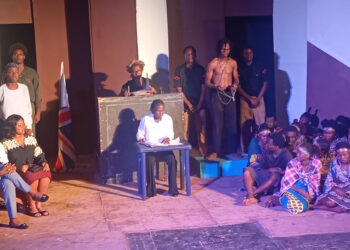
With The Brigadiers Order’s western endorsement comes fame and with the fame a lot of visitors. One such visitor is Nduka, the country’s economic minister, who wants to hire the witches to “use their powers to reveal the solutions to our country’s economic problems.” It beats all imaginations how a minister would possibly think of such a solution and mean it. But it is the mad republic! Even when Osondu tries to provide rational solutions to these economic problems, the minister shows what has already been known: mediocrity reigns supreme in these corridors of power.
OSONDU: Minister, you know we have first-class economics graduates who can work with you and provide permanent solutions to our economic problems.
NDUKA: I saw first-class economics graduates before coming here. The problem with the Nigerian economy has gone spiritual and my office must effect a change. We need a spiritual ministry for Nigeria’s economy (66).
This leaves one imagining the kind of other charlatans this minister must have been employing, for their claims to spiritual powers, while leaving qualified graduates unemployed.
See also: Does Overexposure of the Black Female Body Draw it Closer to a Sell-by Date?
The minister is not the only august visitor received by The Brigadiers during this period. There is Prophet Dan who wants the witches and wizards to work in God’s vineyard since all power belongs to God. The powers of the witches he wishes to use to “manipulate people to fall down and speak in tongues during services.” Prophet Dan’s action is an indictment on the miracles performed by him and so-called men of God like him, seeing that he is willing to stage them. Beyond this indictment though, Prophet Dan’s request points out something important in the character of the postcolonial subject, which is the postcolonial confusion. This confusion is most visible in this play in the religious aspect and the syncretism that comes with it. For example, The Brigadiers go to Church to book Masses so that they will be successful in their application, not minding the subject of their application. The women in the group are active members of their Church’s women group even while being active members of other secret societies. Ekemma still offers roadside sacrifices to her ancestors even as she joins other members of The Brigadiers to go for a Thanksgiving Mass in the Church when they made the shortlist. To cap it all, Fr. Paul, an ordained priest of the Catholic Church, offers prayers for the witches to be successful.
The visit of Moses Oyelakin Tyehimba, aka Black, founder of The New Nigeria Youth Alliance Movement, is used by the playwright to reflect on police brutality in Nigeria, especially as it relates to the youth. The killing of unarmed protesters at the Lagoon Island Gate becomes his way of paying tribute to the killings that happened at the Lekki Tollgate, Lagos Nigeria, on the night of 20th October, 2020, when members of the Nigerian Army opened fire on unarmed EndSARS protesters. Amnesty International reports casualties to be at least 12 protesters. Black is the only visitor who wants to use the witches’ ‘powers’ for the selfless act of wedging bullets from the armed forces as the youths march in protest. Unfortunately, such cannot happen for there are no witches amongst them—just performers.
It is Adaeze’s visit—Adaeze is a gubernatorial candidate—that most illuminates the Nigerian politician’s way of doing things. She urges the teachers to quit their “participation in The Phoenix Black Science Prize and bring the witches and wizards to manipulate my votes during the election and make me win.” She does not stop there. Like all politicians, she plays the emotional trick of identifying and connecting with the suffering masses. “Since I was a girl,” she says, “women have been marginalised in the affairs of politics. In fact, women are marginalised and subjugated in every institution…When was the last time a woman contested for the governorship position of this state? This is the time to rewrite the history of this great state.” Anyone familiar with political campaigns in Nigeria knows immediately that when someone like Adaeze talks of rewriting “the history of this great state,” she is mainly talking of rewriting her own history.
See also: My Ability to Dance and Sing has Played a Big Role in my Career – Dalma
While they tried to resist the tempting offers made by these visitors, they could not, especially after Osondu left with Obichikalu. Ojukwu may be happy that The Brigadiers disbanded and did not head West, but his happiness is never complete for they only substituted one evil with another that may even be greater. While their survival stance of going West can be sympathised with, the reason behind their decision not to go West cannot be sympathised with. It is the proverbial case of the trouble in the land being to the gain of the rulers. Their reason is captured in Osondu’s submission that, “Britain is not the kind of country I would want to live in. They have laws. Here in Nigeria, money is the law.”
A Deficient Character
Modilim’s play is laced with humour and well-developed characters except for the character of Amanda. The playwright seems to know nothing about what a robotics engineer actually does while writing this character, such that in more than two instances where the character is seen talking about her career, she is repeating something about developing “an Artificial Intelligence software, which would enable operating systems to be more intuitive and autonomous in the way they process information”—always the same lines. Also, when she is making the case on why she needs Ifenna and the women to achieve her aim, she says to Ifenna “You will direct the women while I do the wiring.” Wiring of what? No one, not even the playwright, seems to know.
Conclusion
The Brigadiers of a Mad Tribe offers a fresh way of looking at the migration issue we have now termed a “brain drain.” The play remains important because the circumstances that necessitate this drain are still in place, causing even Modilim himself to leave the country a few months after publishing the play. This is to neither say that migration is a negative phenomenon, nor that a country loses when its people migrate—for it is more nuanced than that—but to say, paraphrasing Warsan Shire, that as long as home continues to be the mouth of a shark, every leaving becomes an exercise in survival, one that is mournful for it should not be so.
Art work: the puzzle 1 …collage ..oils and metal… by @Ronex 2025



Discussion about this post