Easily one of my favourites from the Lagos International Theatre Festival (LITF) 2026 is Anthony Abolo’s stage adaptation of Ola Rotimi’s Grip Am, a 1973 farce published entirely in Naija Pidgin.
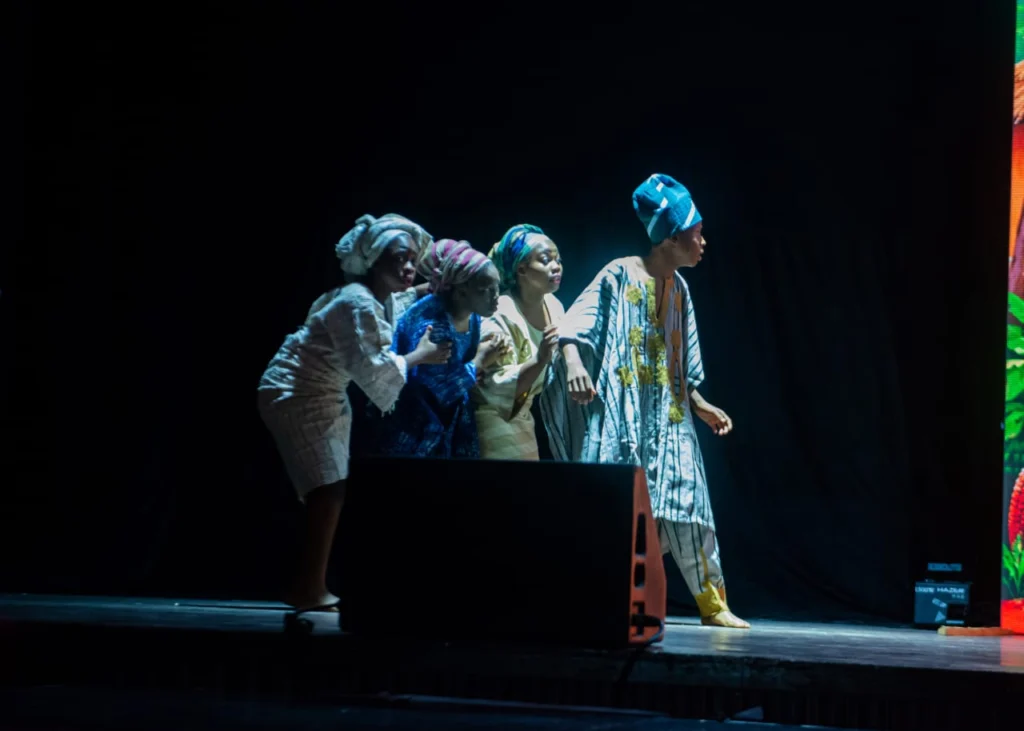
At the heart of Grip Am is familial tension occassioned mostly by poverty. Ise (Chidozie Roy-Omeni) is a poor farmer whose farm yields undesirables and this irks his wife Aso (Babalola Dieko) to no end. She complains to anyone that cares to listen how useless her husband is and nags the poor man constantly, especially when he aims to eat from her pot food he didn’t provide. They are a warring couple. The only thing that yields fruits in Ise’s life is his orange tree, little wonder his extreme attachment to it.
Yet, it is that orange tree and the fruits it bears that unknown person(s) have refused to leave alone for him to enjoy. Anytime he sees a ripe fruit atop in the morning and hopes to feast on it in the evening, he returns to the fruit gone. He has warned and shouted and threatened, even tied charms around the tree to deter the thieves, yet the ripened fruits keep missing.
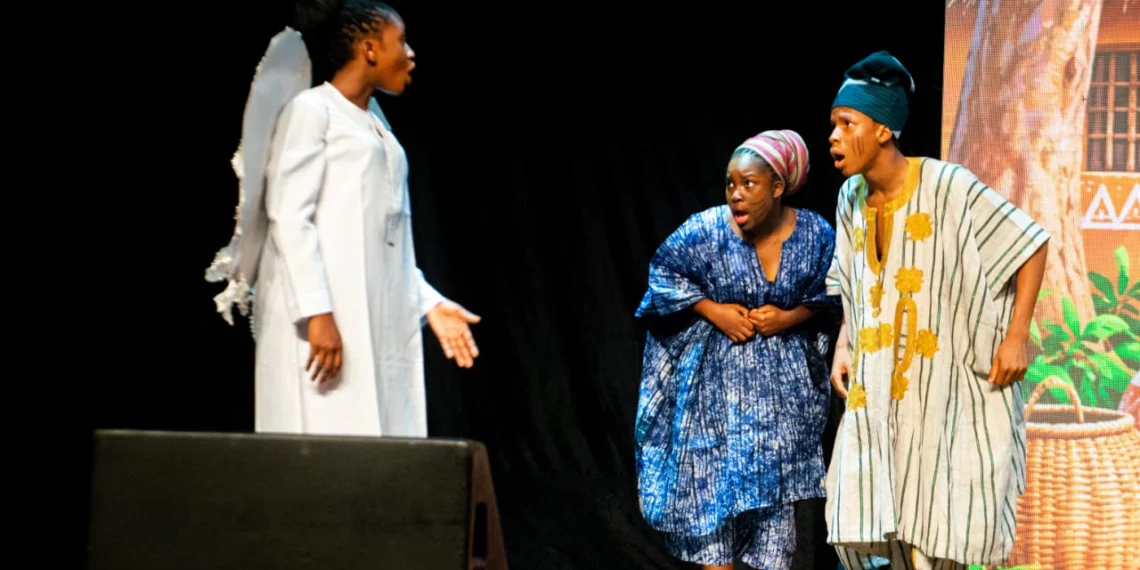
One day in his usual shouting match with his wife, an Angel, played by Brianna Ekpiwhre visits. She is sent to them as an answer to their suffering. They only need to make a wish each and it will be granted. This is where the comedy gathers momentum, a momentum the actors never drop till the end of the play.
See also: Make Room: Brenda Ibara Brings Kabibi and Her Bags to KITFEST
This cast is surely talented, acting like professionals though only secondary school students. In my short career as a theatre critic I have witnessed many student productions at the tertiary level and what these members of the Atlantic Hall Drama Club brought to the stage on the 14th and 15th November 2026 rivals the best of what I have covered. The unmistakable star of the night is Chidozie Roy-Omeni as Ise. His performance is that of an actor in full command of his character, from his facial expressions to his diction and vocal characterization. This is comedy, but this is serious business for him and it is this seriousness of the business, captured by his face permanently knitted and etched in a frown, that heightens the comedic effect of what happens on the stage.
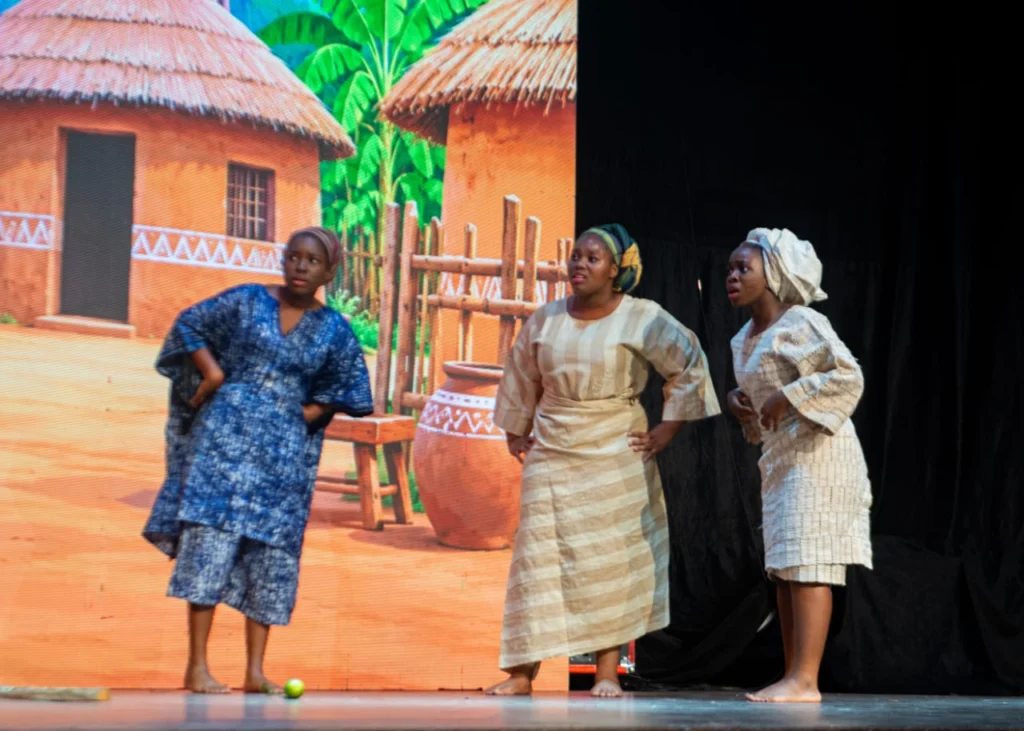
As a nagging wife, Babalola Dieko embodies Aso almost to perfection. When she stands akimbo, her legs vibrating, you know war is about to descend on the household. Atilola Olatunji as Temedu and Kehinde Aderemi as Oye are always ever ready to rush in, pretending to be concerned neigbours but in reality nosy neighbours looking for the next juicy gist. Naetochukwu Mbonu as Oro (the landlord) with a short stage time leaves a large and looming presence, delivering a memorable performance, especially when he cries for having been captured doing the wrong thing.
This play fills one with joy, not just with the actions on stage, but with what the cast and crew means for the future of Nigerian theatre, that youngsters like that abound and are already being cultivated by dedicated teachers to make exploits on big national stages like the Muson Centre where LITF held.
See also: Mariam Ndagire: A Full Career in Theatre, Music and Film
Even as an angel, human beings still shock Brianna Ekpiwhre. What do you mean you have the opportunity to make one request of God, and you a suffering man only requests to be able to catch anyone who goes to your orange tree such that when you shout Grip Am the person gets irremovably bond to the tree until you release them, the shock on her face visibly asks? What do you mean that as a poor woman you have the chance to make any wish and you wish for your husband to die because he’s the cause of your poverty? But those are the wishes Angel receives and those are the wishes granted, starting firstly with Ise’s wish.
Oro is Ise’s first victim. It is not enough that he is the landlord coming to get rent from a man already angry at the thought of paying rent with money he doesn’t have, Oro also steals the only thing the man has, his precious ripe orange. And he gets stuck to the tree when Ise sights him and shouts Grip Am! Ise capitalises on his new power to negotiate a cancellation of all his debts and a handover of the house to him. He becomes himself a landlord and it is while celebrating his new status that Iku (Edwin Ereshie Nchor), Death itself, marches onto the stage, a determined worker in a haste to do his work and go, for as he cautions Ise and others who were begging him to not do his work, he has other works to do at Ikoyi (another area of Lagos). When Ise sees Iku is hellbent on taking him, he makes one final request, mek orange ripe mek I lick. The request is not out of place knowing how attached Ise is to his orange so Iku grants it.
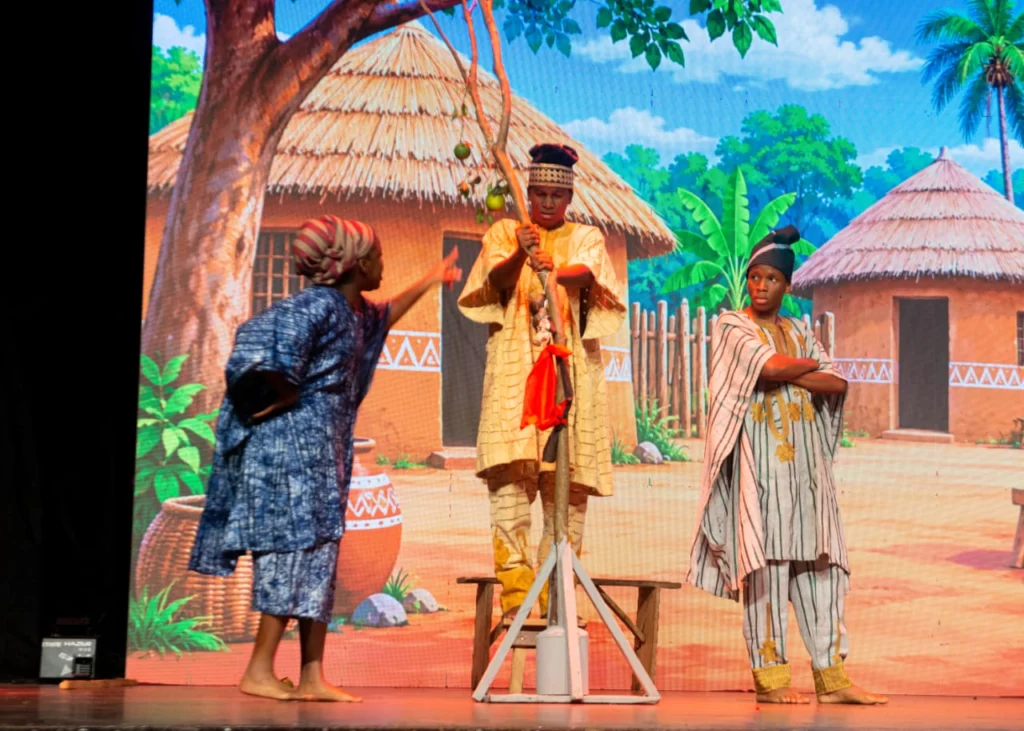
The arrangement is simple. Ise plucks and licks his orange and Iku takes Ise’s life afterward. However, Ise just couldn’t pluck the orange. After feigning difficulty in plucking the fruit, he requests Iku help him, a request Iku quickly grants being in a haste to complete the assignment and leave for the next. As soon as Iku touches the tree, Ise shouts Grip Am and that is how Death becomes the prisoner of man. The man outwits death for “as snake dey plan bite small pikin, na so small pikin dey find stick take kpai the snake.”
See also: How theatre can help young Nigerians who are living with HIV
Edwin Ereshie Nchor embodies ominousness in a way that is at once serious and funny. When man triumphs over him, one sees the pain, the ludicrousness of the occasion written all over his black face (why is death and demons always black and blackened in such plays?). In his movements even he captures the negative nature of what he represents.
At the end of the play, for a lack of unity, the couple remains in their poverty and suffering, their quarrels continue having squandered their opportunity to get a better welfare by focusing on the retributive and destructive rather than the constructive and corrective. Their vision is myopic but not Ola Rotimi’s Grip Am adopted by Anthony Abolo in their choice of language.
“Let no one be fooled by the fact that we may write in English,” Chinua Achebe writes in ‘The African Writer and the English Language,’ “for we intend to do unheard-of things with it.” Here, Achebe instructs that any language given to a people must be domesticated, bent, and stretched to capture the rhythm of the people to which it has been given. Only when that happens can reception be said to have taken place, else it is an imposition. What better reception of the English language has happened in Nigeria than the birth of the pluralities that have assembled to become Naija Pidgin.
Colonial-colonised and master-slave relationships have continued to assault and question the legitimacy of creoles casting them as inferior or broken. Such is the situation that anything that originates from, belongs to, or is used mostly by the masses, by those without power, becomes undesirable to those with power who then empowers institutions to inferiorise and discriminate against it. Such colonial hangovers still exists in our academic institutions where we boldly order “No vernacular,” banning indigenous languages, for somehow the students’ use of indigenious languages hampers their assimilation of the Queen’s English (I guess it’s the King’s English now?), in the Queen’s accent. “No vernaculars” also means “no broken” (as pidgin is framed). It is thus a commendable exercise in decolonising the mind that these students adapt a play written in Naija Pidgin, acting it in that language in which the masses are fluent across ethnic boundaries. The battle is the battle of the mind and the primary and secondary schools especially are the war fronts. What message it passes to the students that that which is used by the masses, that which to an extent is indigenious to them is not an illiterate’s tool but a valid way of being and engaging with the world.
See also: In Tonderai Munyevu’s Mugabe, My Dad & Me, the Personal Becomes the Political
For its decolonialisation project, for its cultivation of the future prominents of Nigerian theatre, for the good works of Karen Biose (Stage Manager), Gracefield Nwokocha (Prompt) and Azriel Oteh (Lighting Designer), for its humorous exploration of poverty, familial strain, exploitation and (dis)unity, and most importantly for the stellar theatrical performance, Anthony Abolo’s Grip Am is nothing short of a true celebration of the Nigerian theatre, ideal for the Lagos International Theatre Festival stage.


Join the conversation