


This year marks ten years since the student-led protests of #RhodesMustFall and #FeesMustFall emerged as an active response to the weighty and intersecting historical and political inequalities that sadly, remain present and continue to perpetuate a plethora of challenges throughout South Africa today.
This reality of unchanging forms the core of the Theatre Duo’s decision to present this reimagined staging of The Fall, in this year specifically – to not only highlight the tragedy of the continued difficulties experienced by large groups of South African students, but to also pay tribute and homage to those who were a part of the movements, and courageously made the choice to put their lives on the line for access to a promised (yet still unaccomplished) free decolonial education. Additionally, it was also incredibly crucial for this reimagination to be staged at the Market Theatre, given the theatre’s historical (and present day) steadfast and unwavering commitment to challenging injustice, through art.

The Fall is an unvarnished collaborative piece of workshopped protest theatre devised by the original cast – Ameera Conrad, Sihle Mnqwazana, Kgomotso Khunoane, Oarabile Ditsele, Sizwesandile Mnisi, Cleo Raatus and Thando Mangcu, Tankiso Mamabolo, with Clare Stopford. When the statue of Cecil John Rhodes was dismantled at the University of Cape Town, these postgraduate students co-wrote this searing play focusing on the cross cutting roles that race, class, gender, sexism, colonialism and the ideologies of patriarchy have to play in the perpetuation of discrimination in our country. The Fall has been seen in South Africa, Europe, UK, and America and was also a New York Times Critic’s Pick, which went on to play to sold-out houses and receive critical acclaim both internationally and locally. This reimagined production (originally produced by The Baxter Theatre Centre) is performed by three of the original creators, Tankiso Mamabolo, Sizwesandile Mnisi and Sihle Shona, along with additional new cast members, Tshepo Matlala, Kevin Narain, Mosehlana Mamaregane and Lechè Tangee.
See also: Handel’s Messiah at The Playhouse: A Glorious Easter Celebration
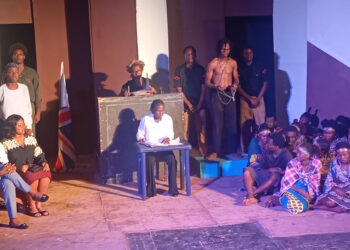
This staging of The Fall prioritises the reignition of discourse and awareness around the intersectional nature of the mentioned issues that coexisted within each of the protest movements, and how their collisions affected (and continue to affect) the collective undertaking to decolonise the student experience. With commitment to the theatre-making style of the Theatre Duo & Co (which centres the exploration and expansion of the interdependent relationship between text and movement) this reimagination utilises the spirit of theatricality to amplify the elements of protest, in order to visually translate the impactful depths of these moments in our political landscape, making them more ‘tangible’ as a means to communicate the evidence of the existing plight of students.

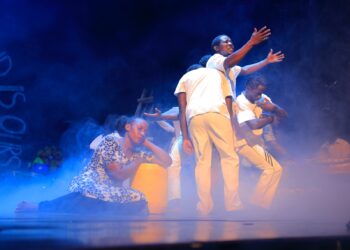
Throughout the production, elements of song, dance, entrancing movement language and fervent text delivery are exercised collaboratively to highlight the nuanced intemperateness of individual experiences of different students within the movements, as well as that of their experiences as a collective of student cadres. The varying treatment of movement, sometimes riotous and other times precisely sedate, serves as both a physical and visual representation of the psychological and emotional rollercoaster that is being a part of any protest demonstration that challenges longstanding systems and institutions.
See also: Senga Brockerhoff’s Every Woman: An Ode to Modern Womanhood
In addition to the unbridled text, this constant contrast propels the story, allowing the hard truths of these protest movements to be expressed unrelentingly – not only are the students/actors provokingly alive and fired up throughout the performance but so are the set tables, representative of the tables around which life altering decisions are made, usually in the absence of those they affect in tertiary institutions. In this work, in these movements, it is clearly apparent that students have grown tired of asking for a seat at these tables. They remove the chairs and stand on top the tables of affairs that impact them directly, without apology.
The combination of original and new cast members also presents a proximate analysis of the relationship between time and the effects of these movements. In process, this ensemble has come to discover (just as the characters in the production do) that even with their racial, cultural, gender, economic and ethical differences, it is indeed possible for each of them to be affected by the intersectional inequalities and discriminations within systems that operate most optimally through measures of othering (which includes most institutional systems).
See also: Phillip Luswata: A Career Onstage and Behind the Scene

This reimagination of The Fall serves as a reflective commentary of the current reality of South African students through personal perspectives, therefore it does not attempt to performatively offer a resolution. Rather, this work makes it a point to place a magnified focus on the lives that were and continue to be deeply impacted by systemic injustice. The struggle for education continues and this reimagination refuses to stage false absolution.
See also: Emelda Ngufor Samba: Scholar and Face of Theatre Arts in Cameroon
Pay tribute to the #RhodesMustFall and the #FeesMustFall movement and homage to those who put their lives on the line for access to a free decolonial education, by catching the internationally acclaimed production The Fall at the Market Theatre from 9 April to 4 May (excluding Easter week).


Ray ID: 8f3a2c1b9d4e5f6a · Performance & security by Cloudflare
site-verification-ok



Discussion about this post