


In This Season’s Harvest, Ikechukwu Erojikwe presents a conflict between material ambition and the spiritual obligations it incurs, a deadly dance, unravelling the extent of human ambition and its consequences. The play was recently staged on 22nd April, 2026 at the Arts Theatre of the University of Nigeria, Nsukka, under the deft direction of the trio, Abraham Ogonna Akamu, Ukamaka Charity Eric, and Emmanuel Tochukwu Igwe as part of the Festival of Nine Plays that ran from 21st April to 23rd April, 2026. The festival marks the culmination of the Directing course for penultimate-year students in the Department of Theatre and Film Studies at the University of Nigeria.
Every man harbours this deep-seated aspiration to live free from poverty. To achieve this, one is duly compelled to pursue wealth and acquire the required material necessities that make for a comfortable life. This relentless pursuit forms a greater part of a man’s struggle on earth. Many people pursue this ambition either as employers or workers in various sectors of society. Although man’s needs are insatiable, there is a boundary to what can be obtained through rightful means. It is therefore unsurprising that many turn to the informal economy, particularly its criminal and dubious aspects, to meet their needs. These pursuits are at the centre of Ikechukwu Erojikwe’s This Season’s Harvest.
Money, Money, Money
The protagonist, Iweka (Dennis Onochie Ekwomchi), experiences a life that begins and ends in sorrow, a tragedy that unfolds from childhood to adulthood. Orphaned as a kid, his early life was one filled with lots of suffering. As an adult, though, he was one of the richest men in his community. On the surface, he appeared to be the perfect example of a self-made man, one who clawed his way from under the dirt to touch the sky. But the truth is messier and less glorious. The introduction of Uzor (Jonathan Leonard Chidi) into Iweka’s life holds the secret of this success story. Uzor is a young man who is ready to dare the devil, pry the crocodile’s mouth open, and dive into the deepest parts of the oceans if that is where the money lies. His life is ruled by three things: money, money, money.
See also: Ku kyooto Rekindles the Fire of Legacy at the Uganda National Theatre
It is through Uzor that Iweka becomes a child of Amuma, a deity administered by Okalammuo (Raphael Chinedu Omeh), known to grant wealth in exchange for the devotee’s peace of mind, though this is not immediately apparent. Amuma’s demands of each harvest increased in difficulty from year to year, from season to season, until they eventually became almost impossible. In the season we meet Iweka, the almost impossible is demanded of him: he is tasked to bring the head of a sixty-year-old virgin man. A command that carries an even heavier penalty, his own life.
“Who wants to dance the dance of death?” Okalammuo asks. Definitely not Iweka, and the rest of the play shows his efforts to avoid this dance through Uzor, his worldly-wise friend.
A Quick Verdict
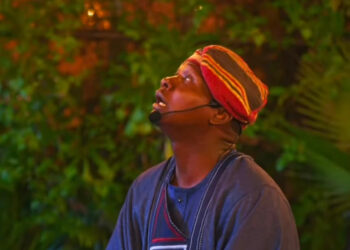
This Season’s Harvest was a success on the stage, a delight to watch. The directors’ realistic approach to the script, even in the face of some supernatural occurrences, makes it one that is easily relatable. Throughout the play, Dennis Onochie Ekwomchi can be seen running around the stage because he sees Okalammuo, who is invisible to everyone else in the room, a gesture that could suggest his growing tension and psychological breakdown, as he begins to perceive what isn’t there. A perfect example of this is a powerful scene where he picks up a newspaper and sees his obituary; it’s this rising hysteria, the fear of a man confronted with death.
The actors and actresses hold their forte, embodying their characters almost to perfection. In Dennis Onochie Ekwomchi, we see not only a man determined to live, but one with the resilience to make it no matter what. However, in all this, his bravado is that of a man scared.
See also: Walking Into The Night To Make A Day: On Uzor Maxim Uzoatu’s A Play Of Ghosts
Jonathan Leonard Chidi, too, stood his ground in his performance, presenting to us a character who never despairs, one seasoned in wicked ways and believes that evil can always be conquered with more evil. Fearless, he is always ready to sacrifice whatever it takes to achieve what he wants, and he has enough heart to give to his friends, but also knows when to disappear, lest the masquerade be felled.
Raphael Chinedu Omeh’s character understands what it means to serve a powerful deity. The audience experiences this in every aspect of his performance; when he speaks, when he laughs, when he moves, it is a powerful demonstration of how one vicariously experiences the terror of Amuma. With the choreographed responses in their meetings and incantations, one has no choice but to be filled with awe at the powers of Amuma.
Franklin Chigaemezu Obuwa, Samuel Mmesoma Nnaji, Clinton Obumnedu Ukatu, Samuel Chizaraekpere Nnamani, Dennis Onochie Ekwomchi, and Jonathan Leonard Chidi, as Children of Amuma, give a brief yet chilling performance. Their responses to Okalammuo—bass-filled—are esoteric in what they induce in the audience. It is through them, beyond even the demands of Amuma, that one feels to what extent Amuma is to be feared.
It is in Divine Chidera Peter, however, that the excellence of acting is felt on that stage. While he plays the character of Solomon, Iweka’s house help, he doesn’t fail to own the stage whenever he appears. Peter’s character is larger than life, a servant whose shoes are bigger than his boss’s, a personality he portrays effectively. In what is otherwise a tragedy, it is Peter’s actions that bring moments of comedy into the play. While Uzor’s rip-off of a famous line from a ritualist character played by Yul Edochie in a Nollywood film brought laughter to the audience because of its relatability, it is how Peter drinks from his master’s bottle, how he mocks his master’s psychotic episodes, and how he hugs and fondles his master in moments of mock scares. It is in his moves and statements, those of a true comedian, that the audience will remember, years from now, as the comedy that defied the tragedy of the play. As far as acting is concerned, Divine Chidera Peter was the star of the night.
See also: Emelda Ngufor Samba: Scholar and Face of Theatre Arts in Cameroon
These performances wouldn’t have amounted to much without the Chorus (led by Uchechukwu Francis Onah) and the lighting of Akachukwu Miriam Nnamani. The duo sets the mood for each scene. While the Onah-led live chorus captivated the audience’s ears, Nnamani’s lighting commanded our eyes. The combination of the two elements helped the audience perceive the atmosphere of the play at every moment. When dull, weak lights flood the scene, and the chorus sings in fear, as though haunted by an unseen presence. An esoteric presence indeed appears on the stage, moving to what the aforementioned combination achieves. their. It is a combination that worked in perfect sync right from the opening of the play. When Okalammuo says, “Let the ritual begin,” it is as though he is referring to the synchronisation of that which appeals to both our ears and eyes (and this includes also the costumes of Eberechukwu Gladys Okoegwu and the makeup of Marycynthia Nchedochukwu Nwosu) to produce an immersive stage experience.
Who Wins the Dance with Death?
In a sense, Uzor emerges as the winner of this dance with death. He is like the proverbial lizard with which every rat is advised not to dance in the rain. He introduces Iweka to Okalammuo, and when Amuma’s demand becomes too much for his friend, he enlists the services of Professor Emeritus, a priestess in a supremacy battle with Okalammuo, to deal with Okalammuo (and, by extension, Amuma). In the end, the dance with death with which Okalammuo holds the Children of Amuma to fear is first danced by Okalammuo himself, the consequence of which becomes Iweka’s new predicament. “This is your new predicament,” Jonathan Leonard Chidi says to Dennis Onochie Ekwomchi, before he, lizard he is, leaves the rain to drench the rat he had brought into it.
Conclusion
Akamu, Eric and Igwe took the script handed to them by Ikechukwu Erojikwe and placed it elegantly on the stage, and translated it into a fun, entertaining production filled with lessons. Most importantly, it announces their arrival as theatre directors to watch out for in the future, and curated a new list of actors that, if they continue at this rate, would in the future prove indispensable to the stage and screen in Nigeria. These are the students who would ensure theatre productions do not die in Nigeria, and whatever shortcomings they may have displayed in their production, this reviewer was too excited to have taken notes of.




Discussion about this post