


Anton Chekhov’s 1889 one-act farce, The Marriage Proposal, has been quite a literary traveller. Its arrival on the Nigerian literary scene though can easily be charted. Through the very important and sacred act of translation, Chekhov’s play was rendered in English, the language of Nigeria’s colonisation. Chekhov’s early farce therefore comes to Osofisan through colonial education in English. That begins the conversion of the play, from a Western classic, to a celebrated African work.
Osofisan’s engagement of The Marriage Proposal which he entitles The Engagement goes beyond a change of language. While retaining the language of the translation, Osofisan engages the work in an adaptation—an adaptation that strips it of its socio-cultural origins while steeping it into the Yoruba’s. Not only do the characters become Yoruba and the setting Yorubaland, in The Engagement, we see marriage from the Yoruba lens, or more accurately, it is the idea of marriage in the Yoruba culture that is explored with the aim of drawing laughter from readers.
The latest turn in this literary travel occurs on the 28th of March, 2025 at the Princess Alexandria Auditorium of the University of Nigeria, Nsukka, where the theatre director, Ejikeme Kosisochukwu, adapts for an Igbo stage The Engagement. In Kosisochukwu’s The Engagement, the characters are Igbo, the setting Igbo, but marriage, or specifically, marriage proposal, is still something to be laughed about, something to be laughed at.
See also: YDC Theatre Calls for Investment in Children
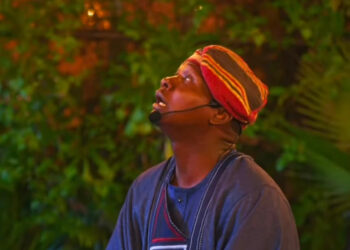
The stage opens with Chief Chibuzor (Adesunloye Oyindamola), the typical Igbo businessman, going through his records in his sitting room, while punching his calculator. Beside him are a drum and a guitar, an indication that Chief Chibuzor may be a music fan, and he indeed is a good drummer. Chief Chibuzor is later joined by his hypochondriac friend, a younger and bigger Chief Nzeribe (Ugwuoju Henry). Nzeribe’s big stature is accentuated with his free flowing impeccable white traditional dressing, a red cap atop indicating his status. His rich dressing is explained by the fact that he has come into wealth through government contracts. Chibuzor is happy to welcome his younger friend who he has not seen for long, and they spend time discussing and making music (Nzeribe is himself a guitarist), even as Chibuzor wonders what might have brought his friend, especially as he dresses like someone on a serious mission.
Chief Nzeribe is an anxiety-stricken man. He suffers from anxiety about his health, anxiety about his mission, and just plain anxiety. He tries to relay his mission but only sweats, asks for water and makes incomplete and sometimes totally irrelevant sentences. Ugwuoju Henry plays this role of a big man reduced to a sack of anxieties to perfection. We see the struggle to state his mission in his face, even before he coughs or have palpitations or just speak like someone at the early stages of losing his mental faculty.

From here, Kosisochukwu’s adaptation, true to Osofisan’s, becomes a character study. Chibuzor is the main character being studied here, as we see how he reacts to his friend’s anxiety. While pretending to be a good friend who is always ready to help, dancing to Nzeribe’s lyrics that “I may not have money but with you I’m rich,” the audience sees him as the friend ready to mock another’s financial difficulty. In an aside, he makes fun of Nzeribe, accusing him of dressing rich to come and beg money and now being stuck as to how to go about it. When Nzeribe finally states his mission to marry Nneka, Chibuzor’s daughter, we see joy return to Chibuzor’s face as he becomes the good friend, again.
See also: Handel’s Messiah at The Playhouse: A Glorious Easter Celebration
Oyindamola’s short stature makes him fitting for this role of the mischievous elder. His carriage of himself, and his choice of words, almost passes him as a member of his character’s tribe, even if his accent sometimes gives him up. And it is here that we see the actor that he is, as he crosses the cultural divide, from Osofisan’s adaptation to Kosisochukwu’s. He also does not rely only on his words to evoke laughter, his mannerisms are themselves so funny that you are already laughing before he opens his mouth. And same can be said of Odoh Jennifer who plays Nneka, Chibuzor’s daughter.
Another funny process is triggered when Chibuzor leaves Nneka to interact with Nzeribe who has come to ask for her hand in marriage. While the shy Nzeribe struggles to strike the pose of a lover, the more assertive Nneka makes this almost impossible for him, still seeing him as her brother considering the relationship between the two families. What is supposed to be a marriage proposal becomes a heated debate over land ownership. While Nneka argues that the land in question was given to her father by her grandmother (“my father’s mother”), Nzeribe argues that the history goes beyond that. “My father’s father gave that land to your father’s mother.”
Their noise attracts Chibuzor back into the sitting room. He is shocked to discover that instead of being in each other’s arms, the couple are at each other’s throat. But when he learns the subject of the debate, he sides immediately with his daughter and that further escalates the issue, with insults freely flowing from one person to another until Chibuzor pushes Nzeribe out of his house.
See also: Phillip Luswata: A Career Onstage and Behind the Scene
All this while, Nneka was ignorant of the true nature of Nzeribe’s visit. When she learns of it after Nzeribe has left, she cries to her father to call him back and reconcile with him. It is true that Nzeribe is single at forty-nine, but so is Nneka at thirty-six. Time, they both believe, is not on any of their side and that explains the ease with which Chibuzor persuades Nzeribe back to his place to finally propose to his daughter.

Only that he doesn’t. Their disputatious nature leads Nzeribe and Nneka to raise another debate over the most mundane of things: their dogs. Their argument over who owns the better dog draws Chibuzor back to the sitting room and while he berates them for engaging over such a meaningless debate in the face of a better discussion, he does not resist the temptation to side with his daughter and the debate escalates to the point that Nzeribe, shouting at the topmost of his voice, collapses. Father and daughter are scared and try to resuscitate him, an attempt at which they are successful. Nzeribe picks his guitar again to serenade the auditorium with the best of tunes.
In Odoh Jennifer, we see a strong female lead whose assertiveness is only briefly tempered by the societal pressure of marriage. Jennifer understands exactly who Nneka is and we see that in her actions on stage, whether she is playing the childish Nneka asking for gifts, or the assertive Nneka fighting for her properties or the emotionally damaged Nneka wrecked by an anxiety of remaining unmarried all her life. Oyindamola’s move is also that of the businessman who wants to win over time, immediately joining Nzeribe and Nneka in marriage instead of waiting for Chibuzor to take the initiative after Chibuzor’s close brush with death, packing up his daughter’s properties himself and throwing husband and wife away from his house when they return to their usual arguments in the final scene that brings the short play to a close with a banger.
See also: Billy Langa and Mahlatsi Mokgonyana on Pushing the Boundaries of the Craft
The Engagement makes fun of the systems and processes that lead to marriage. Ejikeme Kosisochukwu’s adaptation though is very light-hearted. It invites viewers to forget about the serious and sadder things of life as it transforms the very serious institution of marriage to entertainment. Kosisochukwu’s vision is properly executed by the three-person actors who brings in humour not only with the words they speak and the actions they perform, but also by mere being on stage. The scene where Henry goes on his knees and with all seriousness proposes a hunting game to Jennifer remains unforgettable for it shatters every expectation of not just Jennifer’s character and her father’s, but also that of the audience.
But the best moments are the unscripted ones. We see Ugwuoju Henry’s intelligence as an actor play out at the scene when he was discussing his interest in marrying Nneka with Chibuzor and there was a campus-wide outage of electricity. In the short time taken to restore power to the auditorium through an alternative source, he had, standing on his feet, thought of how to salvage the situation. When the light comes on, Henry stirs the conversation towards the issue of unsteady electricity to look as if it only happened on stage, in Chief Chibuzor’s sitting room. More creatively, he doesn’t go about lamenting the event, rather he capitalises on it as a means of getting Chief Chibuzor to like him the more by providing him two sets of generators to make sure he never suffers lack of electricity again.
It is brilliant moments like this, and the laughter the play evokes, that carries Ejikeme Kosisochukwu’s The Engagement through the night. The undisputed star of the night though is Baba Daniel Danlami’s-led music team. Their diverse play-list covers different genres and periods of music, and whether they are playing an Afrobeats love song or a highlife song that celebrates brotherhood, the music team with their diverse set of instruments continues to raise an already-raised spirits of the audience, to the extent it almost looks like a musical sponsored by Chief Chibuzor, as a music fan. They are the heroes of Ejikeme Kosisochukwu’s night.
Ejikeme Kosisochukwu’s The Engagement is thus a celebration of music and comedy, a classic example of the theatre’s role as a source of entertainment.




Discussion about this post