


My new house at Ugep. What that house cost me is my secret. The doors were sliding doors. The floor was tiled with Italian Carrera marble. The walls were sprayed with terracotta. The roof was brittle asbestos. The ceiling made of brisket. And the parlour? The parlour was rugged with velvet. (pause) There were twenty-five bedrooms; it was a duplex. Seven bathrooms and seven toilets. Every room was air-conditioned. Every window was glazed with silicon. The chairs were imported from France. The tables were chrome-plated. The side stools were silver-coated. But now, in-law, that splendid house, that magnificent house with all its beauty has been burnt. Burnt to cinders. Burnt until there is nothing left but a heap of stones and bones.
Those are the words with which Senator Arikpo, a politician rejected by his people, describes his house bombed by the angry revolutionaries that are members of his constituency, in the play. As far as Arikpo is concerned, “The Unemployed Youths Association” who took that measure are the “Devil’s own brigade! A miserable mob of jobless young men and women.”
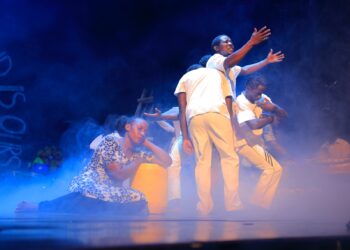
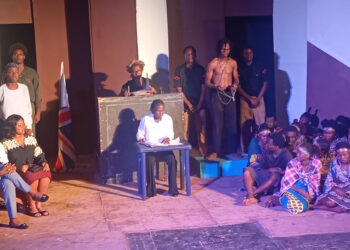
This divide between the leaders and the led, the mistrust and the derogatory nature with which the two classes view each other, is at the heart of the late Nigerian playwright, Esiaba Irobi’s Nwokedi, which was first performed on April 1987 at the University of Portharcourt as the University of Nigeria’s entry in the annual Nigerian Universities Theatre Arts Festivals, and later published in 1991. While the unemployed youths view Senator Arikpo, a representative (together with Nwokedi Snr.) of the political class, as a corrupt man, “a political obscenity” who diverts public funds to his own pocket, the latter in turn sees them as “a harvest of political illiterates,” “pieces of dirt,” and “louts who cannot find jobs for themselves” and instead wait upon him, an individual, to “bulldoze the senate into manufacturing jobs for the jobless multitudes parading the myriad streets of this nation.”
In his lamentations at the opening of the play, Arikpo presents himself as a victim, a politician sinking under the unreasonable expectations placed on him by the younger members of his constituency. This picture that he tries to paint of himself, however, does not hold when one considers the splendour of his “magnificent house” raised within six months after the former was razed down by soldiers on a rampage in what is referred to as the “Ugep Disaster.” Even more telling, later in the play, is when Nwokedi Snr learns, albeit wrongly, that Nwokedi has agreed to tell Ozoemena Nwakanma to step down from his political position for Nwokedi Snr on the condition that the latter provides jobs for the Ekumeku and he happily accepts that as a simple task that can be organised between him and the Senator.
See also: Robert Serumaga: The Pantheon of Uganda’s Theatre in the ‘70s
Nwokedi dramatises everything wrong with the Nigerian state as of when the play was written. Unfortunately, those ills still exist today. In fact, they have become more menacing. From military oppression wrought on innocent civilians, to endless and mindless exploitations of the citizens by their rulers, there is no shortage of the ills seen in Nwokedi in the present Nigerian state (and by extension Africa). The “Ugep Disaster,” for example, calls to mind two such massacres in the past. The first is the “Asaba Massacre” during the Nigerian-Biafran war where men and boys were rounded up by officers of the Nigerian army and shot dead at the Ogbe-Osowa Village, for committing no other crime than coming out in their numbers to plead allegiance to the Nigerian government instead of the Biafran. The other is the “Odi Massacre” carried out still by members of the Nigerian Army at Odi in Bayelsa State in 1999 that led to the death of about 900 civilians.
These historical events captured in Nwokedi are not history. They happen almost daily, mostly on smaller scales, in present day Nigeria. Police and the military brutalising innocent citizens, especially the youths, seems to be the default state of the nation’s existence. Given that Nigeria is a place where history—the ugly type of history—repeats itself, 2020 saw the countrywide youth-led EndSARS protest against police brutality disrupted, not by the police, but by the Nigerian Army which declared war on the protesters armed only with their voices and the Nigerian flags they were waving in hope of a new Nigeria they’d be proud of.
When one considers the blood of the unarmed young protesters shed at the Lekki Tollgate during the EndSARS protest by state actors, the violent tendencies of Nwokedi, the protagonist of Irobi’s Nwokedi, begins to make sense. In Nwokedi, Irobi creates his idea of a perfect revolutionary. He must be one who rejects every form of nepotism, focusing only on the collective good. Nwokedi does not support his father, the parliamentarian Nwokedi Snr., in his bid for a re-election not minding that he is his father. For Nwokedi, all that matters is that the man campaigning for a re-election, no matter what blood tie they share, reneged on all the promises he made in his first bid. Sabotaging his father’s campaign in the presence of his father, Nwokedi reminds the Ekumeku, a group of youths he leads, more or less a version of the Ugep’s Unemployed Youths Association, that instead of giving them the employment he promised, his own father has ensured that their “job in this village is still to look for jobs,” and therefore they must not wait and watch their “future shrink like the meat of a tiger in the pot of a roguish hunter.”
See also: Emelda Ngufor Samba: Scholar and Face of Theatre Arts in Cameroon
Such a wait in lamentations rejected by Nwokedi here is same with the youths of EndSARS rejection of silence in the face of police brutality. By embarking on the protest, the EndSARS youths try to seize agency for themselves, to take their own future into their hands, but they were people with mere clothes in front of people armed with assault weapons. The youths of EndSARS, it seems, overrated the place of the country’s flag, that supposed symbol of unity, and were in for a shock when the white part of the flag got coloured red, with their own blood. For Irobi, years before this protest which he did not live to see, the ideal young revolutionary must be one who is not afraid of the state’s security agents, those weapons wielded by the elites against the “menace of unemployed chimpanzees” and hungry members in the society. In fact, the ideal young revolutionary must in fact actively disrespect these constituted authorities and must be ready to even take up arms against them.
This ideal young revolutionary—who must look beyond blood ties and ethnic affiliations; who must resist, even if militantly, the uniformed “zombies” and disown the failed political class—he creates in Nwokedi. This ideal revolutionary must be able to use whatever small platform he has, like the Ekumeku, to organise assaults that will destabilise those elites with bigger platforms, after all, whatever platform the elites may possess is given to them by the people on the day of election. Irobi’s ideal revolutionary must be able to strike the sword, not metaphorically, not figuratively, but literally. This important ingredient in the recipe of Irobi’s ideal revolutionary Nwokedi has in excess. He is a young man prone to violence and is not afraid to kill if he believes it is necessary to do so. Nwokedi is that self-righteous revolutionary, filled with a sense of self-pride and justification; he is not afraid of blood, rather believes that blood “renews the face of the earth.”
The idea of a sacrificial lamb, in essence a blood that “renews the face of the earth,” is one that is found in almost all ancient cultures and religions. In the Old Testament, animals are sacrificed to appease for the sins of humans. They are sacrificed in thanksgiving and are also sacrificed when the need arises to plead from God whatever it is his people, the Israelites, may need. This animal sacrifice, though potent, is not potent enough, the New Testament tells us, to be permanent—not potent enough to renew the face of the earth. A stronger blood is therefore needed for a one-off sacrifice that will connect God and his children and which blood is stronger than that of his son in human flesh? Human sacrifice therefore is considered as the most potent in many religions of the world, especially in times past. This is so even in the Ekpe masquerade cult, a cult in which Nwokedi is a central member. In the past, this masquerade cult perform its annual cleansing ritual with human blood but with time a sacrificial goat is used to replace humans.
See also: If There is No Message, What are We Doing in the Theatre? – Paul Ugbede
Nwokedi is now in his seventh year of his communal service as the Ekpe after taking over from his father and believes not only in his matchet as an “unconstituted authority” that must be used to sever the heads of the malicious members of the “constituted authority” but also that the caterpillar must die for the butterfly to fly; the old must give way for the young to rule and when they refuse, they must be removed. In his seventh year as the Ekpe, a number that translates in Igbo mythology, to the fullness of time, Nwokedi decides that the head of a mere goat will not do. The land must be cleansed with the “cruel blood” of those who desecrate it with their “political witchcraft”. He, thus, orderes that Arikpo—the senator who murders Nwokedi’s sister, nephews and nieces, and on a collective level figuratively murders the future of the youths—must be brought before him, to be slaughtered like a goat. The greatest tragedy then occurs when instead of killing only Arikpo, Nwokedi also severs the head of his own father who rushed in to rescue Arikpo from his son’s blade. This patricide gets the people asking “is this what has happened to us?” a question that may as well mean, “have we become monsters, just like the people we claim to fight.”
Nwokedi shows Esiaba Irobi as a playwright par excellence. His use of words matches the energy with which the actions of the play roll out and gets even the reader charged. Arikpo while speaking of the youths says that “murder marches in their minds with militant feet” and that “violence roils in their veins like viruses.” The alliteration employed here imitates the movements written about. Irobi tries, successfully, to ensure that his reader not only read about the murder marching, but uses sounds to make the reader feel this. Likewise do we feel violence roil, do we feel it surge through the veins of the youths. It is therefore a play whose mere reading is as rewarding as seeing it staged.
Irobi believes that time will trip the tyrants. This is grounded in the Igbo philosophy of “nwa mgbe nta,” that idea that no matter how dark the night is, with dawn comes light. But in Irobi’s philosophy, this saying must not be employed passively, for as Ozoemena says in the play “Time is not the tick-tock of your wristwatches” rather “Time is action” and only when time is action does it indeed trip tyrants. While it is very easy to agree that it is only the active type of time that can indeed trip tyrants, Nwokedi as a play invites its readers to examine the type of action that is needed. It may seem clear that the playwright does not have any problem with armed revolutions insofar as it is for a common good but the ending of the play does indeed problematize this suggestion. It is important to note that the military takes over the government towards the end of the play, the same night the Ekpe masquerade sacrificed the two politicians of the old order in the play. The military though has been shown to be a ruthless group of people with “anthill mentality” in the play and, therefore, one does not expect this action, even though supposedly done for the common good, to yield good results. Extra-textual evidences abound in Nigeria and in many other African countries that has been unfortunate to experience a military takeover of government that while this sort of action may trip the civilian tyrants, it merely replaces them with their military counterpants.
See also: Hope Azeda and Her Art that Heals
Nwokedi, as a revolutionary force, is at the heart of the debate that the ending of the play raises. The people’s cries of “Is this then what has happened to us?” is not a cry of celebration but one of lamentation. It is the sort of lamentation that comes immediately after a celebration, the sort of lamentation that follows most evenings after a military takeover has been celebrated in the morning. In that questioning cry, the people acknowledge that they have created a new monster while trying to fight the old; they have become the murderers they condemn. With Nwokedi now lies the ultimate power to destroy every (perceived) enemy of the people and what is the limit to which a man who killed his biological father and his father-in-law and is ready to smash his mother’s head against the walls and watch her “illiterate brains surge out like congealed milk” can go?
Twenty-seven years after Nwokedi was first staged, Nigerians and Africans as a whole is still on a search for that sort of active time that trips tyrants and what is evident, from Nwokedi as from Africa’s extra-textual romance with militant revolutionaries, is that violence rather than save us creates but new monsters for us.
Artwork: Couple loosely coupled, fabrics and acrylics on canvas by @ronexarts 2025



Discussion about this post