


On the 29th night of May, 2026, a theatrical excellence, A Tale of Two Nnamdis by Tobe Osigwe from Paul Robeson School of Drama, Theatre and Film Studies Department, University of Nigeria, became the driver of thought-provoking conversations at the centre of governance in Anambra State, Nigeria. Right there at the stage of the Banquet Hall of the Government House, in a Command Performance for the governor, Chukwuma Soludo, the lives of two Nnamdis, both Igbo sons of different generations, both with a large following, were dissected in the production directed by Uche Nwaozuzu.
The production by Ikolomuo Media (in partnership with the Igbo Integration Movement) comes as part of the first Igbo Conversation Conference, “a yearly conference for Ndi-Igbo, the people of the South East, to come together to discuss” the issue of Igbo marginalisation in Nigeria, an issue so powerful in its framing that it gives rise, regularly, to secessionist groups. It is this issue that made the second Nnamdi of the play a prominent voice in Ala Igbo, and his reign of terror is juxtaposed with the reign of an earlier Nnamdi, the Nnamdi Azikiwe, Zik of Africa.
A Tale of Two Nnamdis opens in a village square where the villagers, mostly young people, gather to elect their leaders, and have to, before voting, the individuals contesting first agree amongst themselves the type of leaders they want. Their decision lies between two heads: one who leads through terror, and another who uses diplomacy. In their debate, some voices frame diplomacy as cowardice and tyranny as courage. As the debate rages, an old man (Daniel Chibuko), symbol of wisdom and experience, arrives on the scene and requests to tell them a story which would guide them in their decision. While the majority agrees to hear the old man’s story, the minority, those who view tyranny as courage and generously use violent rhetoric in debate, question the usefulness of storytelling, of mere ‘moonlight tales,’ to the human person in such a crucial moment.In that moment, the play questions and justifies itself. What is the relevance of the theatre to such ventures as reconciliation and peace?
See also: Cultivating Our Next Theatre Directors in the Festival of Nine Plays
The play is a timely one that transports its audience to a past that begs to inform the present with one simple request: to make sense of the future, and in less than nine months after this wondrous premiere, the country goes to the polls, setting the play into motion, and asking, “What is the place of the theatre in the election?” This play strives to answer this question, offering an overall justification of storytelling at a pivotal point in Nigeria’s history. It is through stories such as these that we know ourselves; it is by knowing ourselves that we learn from our mistakes and never repeat them.
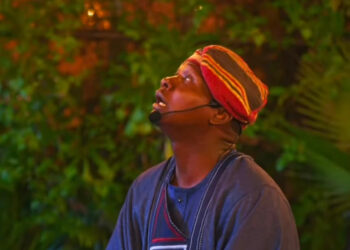
When the old man is finally given the chance to tell his story in the Tale of Two Nnamdis, Daniel Chibuko’s brilliance as a storyteller shines through. He moves from one end to another, like a sage, using Igbo proverbs and idioms to spice his story. My favourite line comes when he explains that disagreements are not confrontations. When two brothers disagree, or when people in a kindred meeting seem to be quarrelling, what is taking place is not a quarrel at all, but the Igbo republican spirit in action, the spirit of onye kwuo uche ya, letting each person speak their mind. This spirit is known to bring progress, for it demands that everybody says what they think so that everybody will be heard and every opinion considered. He tells of Nnamdi Azikiwe, the first Nnamdi of the tale, the one who “sought liberty through light.”

It is Nnamdi Azikiwe who sneaked into the United States to get a formal education, returned to Africa to found the West African Pilot, a newspaper through which he fought colonialism, even in the face of the sedition bill. It was through that newspaper that many young men were inspired to acquire advanced education and use it to develop Nigeria. It is Nnamdi that sought a united Nigeria, a united Africa, free from foreign oppressions, one in which one’s neighbour is truly his brother, and not an enemy (Agbataobi onye bụ nwanne ya). It is the Nnamdi that founded the University of Nigeria, the Nnamdi that remained strong and resolute in his fight for the independence of his people, yet never gave anyone a gun. It is that Nnamdi that Nnamdi Ugwu, his namesake, resurrected on that stage. Ugwu did his homework well, and it showed in how he carried himself and spoke. He played Zik to perfection, a perfection made possible not just by his acting skills but also through the thorough work of the Costumiers, Nneka Ibeli and Eberechukwu Okoegwu. Okoegwu and Ibeli dressed every single personality in the play, especially the two Nnamdis, in such a way that you do not need to be told who is who.
See also: Trauma, Faith and Identity Jonathan Sasha’s Die Stoep
Zik’s approach inspired young people like Christopher (Emmanuel Ezenwamma), modelled after one of the best administrators of the Igbo land, Christopher Nwafor Orizu, who came to him angry about the maltreatment of Nigerians under the colonial masters and seeking weapons to fight with, to get educated, for that is the highest weapon for fighting oppression. An educated and emancipated mind is the one difficult to enslave, and it is like the snail that glides through thorns with its smooth tongue. The second Nnamdi, though, the character Nkanu (Benedict Odunze), modelled after the living and imprisoned Nnamdi Kanu, leader of the secessionist group, the Indigenous People of Biafra (IPOB), is the opposite of the first Nnamdi.
Nkanu seeks liberation “through fear.” He enslaves his people to free them. And Benedict Odunze, with his head shaven mirror-smooth, in his white Gucci top and trousers, plays this character excellently. Perpetually angry, he has no patience for people who seek to advise him, for educated people like Chiemeka (Gift Ogbonna) who refuse to pick up or donate arms and ammunition, preferring instead intellectual solutions. ‘Otellectuals’, he calls them, an Igbo corruption of the word intellectuals that suggests they think from their anus. Efulefus, they are useless people, animals jumping around in the zoo, his preferred designation for Nigeria. There is no shortage of curse words for anyone who disagrees with him, questions him, or advises him. He goes about seeking arms, and while Zik inspires people like Christopher to become great leaders, Nkanu’s ardent followers pick up arms and constitute terror, unexplainably, to the same people whom they claim to be fighting for. Zik, on the other hand, insists that one’s neighbours are his siblings. Nkanu sees his Nigerian neighbours as the human incarnations of the devil, using all sorts of ethnic slurs on them.
A Tale of Two Nnamdis resolves Nnamdi Kanu’s extrajudicial extradition from a neighbouring country into Nigeria cleanly as a wonderful intelligence operation carried out by Agent (Collins Sutuom) when Nkanu went into the country seeking arms with which to destabilise Nigeria further. That is the director’s and playwright’s cop-out of the thorny legal issues surrounding that extradition. It is a failure for justice to be done, in such a theatrical production, not only to the victims, but also to the victimiser and the state. No justice is done to Nnamdi Kanu at that point in the play, considering that the fictional recreation cannot be separated from the factual happening.
See also: Wassanyi Sserukenya lived a full life
A Tale of Two Nnamdis tackles heavy themes but never bothers the audience with them. It is lighthearted and humorous and succeeds as entertainment. The production was appealing to the eyes and soothing to the ears. Anyone familiar with plays staged at the Arts Theatre of the Department of Theatre, University of Nigeria, knows that theirs is a theatre of dialogues and music. That is the same model they bring to A Tale of Two Nnamdis; one would be forgiven if, at some moments, they mistook the play for a musical. Sophia Ikebido and Hephizbah Francis as soloists sang Ala Igbo awake that night, and their Orchestra’s (Nathan Ede, Franklin Obuwa, Martin Ugwu, Peterdemian Omakoro, Favour Okafor, Kosisochukwu Onyibor) fervour was matched equally by the Dancers. The story was told not just by the actors and actresses, through their dialogues, but also by the lyrics of the songs, by the steps of the dancers and by the light and set designed by Richard Ndu Umezinwa, Abraham Akamu, and Akachukwu Nnamani (the last two were also part of the crew of This Season’s Harvest, Akamu as the director and Nnamani as the Light Designer). Theirs was a set that made more of less, using traditionally patterned fabrics to bring colour on set, and matching and enhancing the energy of the dancers, the violence that took place on stage, the strong steps of the Masquerade (Clinton Ukatu, co-director of Dance of the Ghosts) with the lights. It feels good to see what they could achieve in a better light environment, having seen what they have been doing with the little at the Arts Theatre.
Ifeoma Chukwuemeka, as the Stage Manager, was the silent hero of the night. She properly blocked the stages. Though at every point there are lots of characters on the stage, every movement is a meaningful one that contributes to the story, no overspill, save for some moments of movement backstage interfering with what was happening on stage. Clinton Ukatu also returns as the Property Manager.
Tobe Osigwe’s A Tale of Two Nnamdis succeeds at initiating and driving the conversations intended by the playwright. At the end of the play, audience members, high-ranking individuals in the state, sat in circles to discuss, to disagree and to agree. The governor shared his thoughts publicly, and even the next day, during the Igbo Conversation Conference proper, speaker after speaker referred to it to buttress their points. What becomes evident is that excellence in the theatre can provoke conversations that can lead to actions that can lead to excellence in the larger society. Tobe Osigwe, one of the conveners of the conference, himself a thespian and playwright, understands this and brought theatre right to the heart of governance, in the presence of the state governor, and the speaker of the state House of Assembly, and Vice-Chancellors of universities in the state, and mayors of different local governments of the state, and many other dignitaries, the people normally referred to as the stakeholders. Now, it is time they take it outside of the Government House, where only invited and pre-screened individuals could enter, to the masses, the real stakeholders, who need this conversation the most. It is the masses who need to know that no matter the Nnamdi they follow, whether they believe in progress through one Nigeria or the separation of a certain group in the country into a different country called Biafra, what is most important is that liberty, any true liberty, must be sought through light, else the difference between the oppressor and the oppressed is only opportunity.




Discussion about this post